Your monthly update on innovation and deployment for Europe’s railway system of the future.At its 18th meeting, the...
Innovation Pillar, System Pillar and Deployment Group – October News
read more


A body of the
European Union

Access the list of all EU-Rail Calls for Proposals.

On 21 June 2024, the Governing Board of Europe’s Rail Joint Undertaking (EU-Rail) adopted a Call for Expression of Interest (CEI) with a view to selecting associated members with the potential to contribute to the achievement of its objectives. The Governing Board decision can be accessed here.
Discover detailed information about procurment rules and information.
Access detailed information about past tenders.

Europe's Rail regularly published Calls for Tenders. To find out about open Calls, follow link below.
Article 15 (Principle of transparency) of the EU-Rail financial rules states that the JU shall make available on its internet site no later than 30 June of the following financial year information on the recipients of funds deriving from its budget.

EU-Rail’s Innovation Pillar (IP) is tasked to deliver operational and technological solutions that contribute to a more efficient, flexible, and demand-led, yet safe and environmentally sustainable European railway system.

The System Pillar provides governance, resource, and outputs to support a coherent and coordinated approach to the evolution of the rail system and the development of the system view.

The Deployment Group advises the EU-Rail Governing Board on the market uptake of rail innovation developments and support their deployment.
For a successful and effective implementation of the Digital Automatic Coupler for European rail freight (DAC), it is of crucial importance to have open, close and efficient cooperation between rail stakeholders. The European DAC Delivery Programme enabled by Europe’s Rail, offers a unique European platform for such cooperation and collaboration.

Discover how Europe’s Rail Joint Undertaking is calling for a bold, coordinated investment strategy to simplify and modernise rail systems across the EU. This public-private partnership model – outlined in our High-Level Paper – proposes an €18 billion investment from 2028 to 2034 to strengthen European competitiveness, deliver greener transport, and drive technological sovereignty.

The Shift2Rail Joint Undertaking is the predecessor programme of the Europe's Rail Joint Undertaking (EU-Rail), established by Council Regulation (EU) 2021/2085 of 19 November 2021.
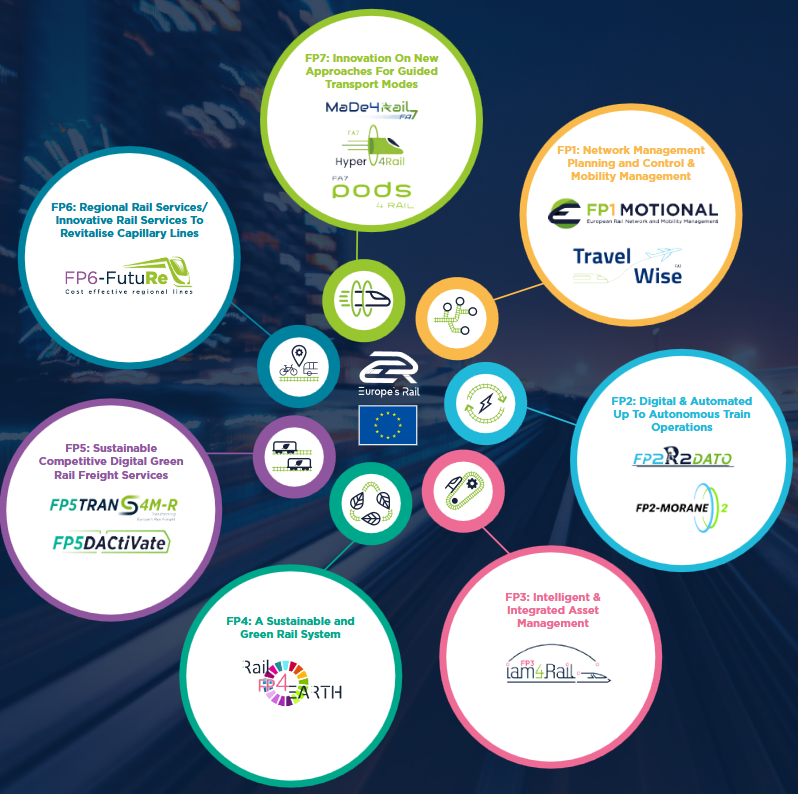
Discover detailed information on Europe's rail innovation initiatives, showcasing flagship and other projects aimed at enhancing rail systems across Europe. It highlights collaborative efforts funded by the European Union to develop sustainable, efficient, and competitive rail transport solutions.
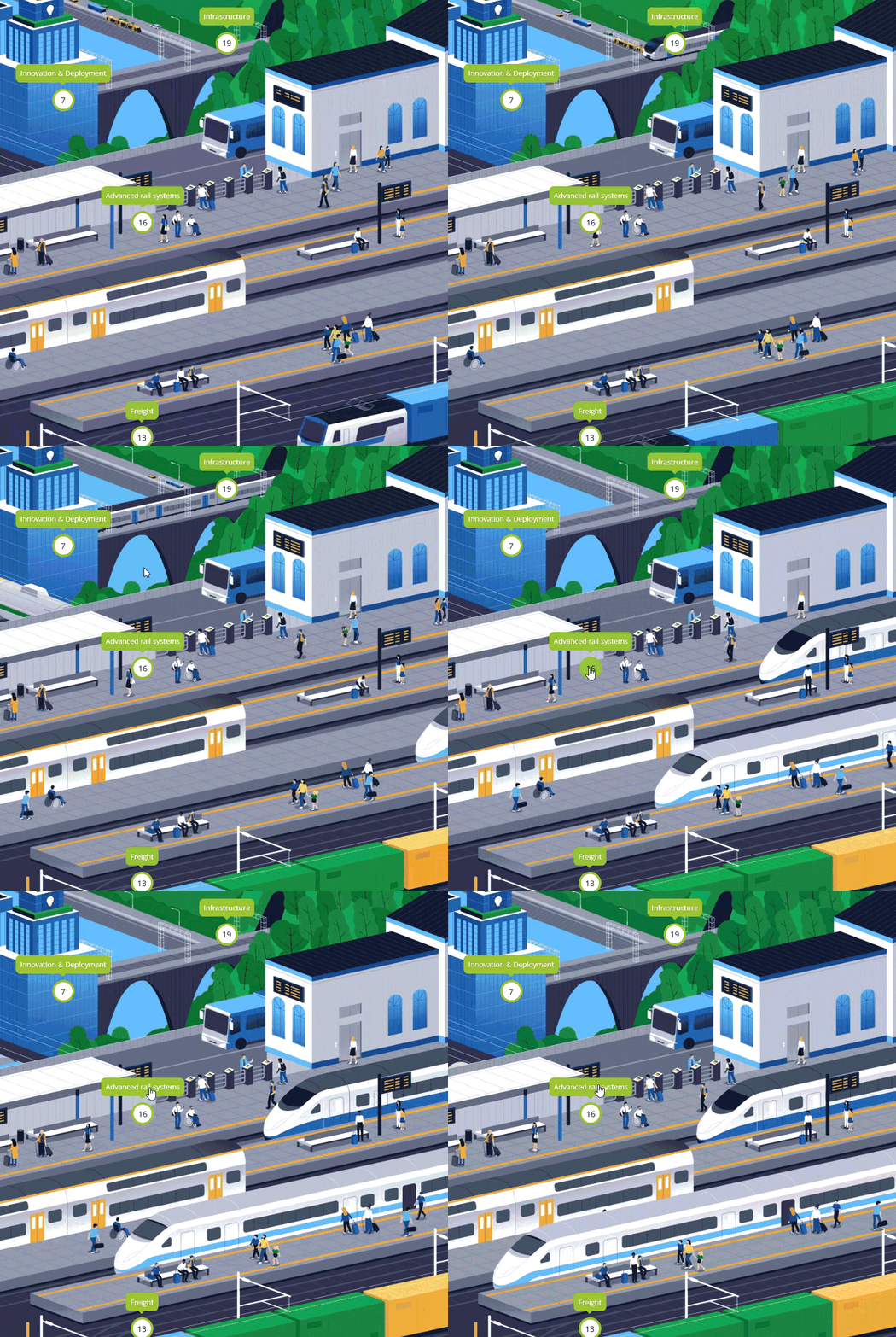
It showcases successful research and innovation results, highlighting their potential as market-ready solutions and the benefits they offer to rail stakeholders. It also emphasises how integrating demonstrators into market solutions can drive future rail innovation capabilities.
Europe’s Rail Joint Undertaking (EU-Rail) is the European partnership on rail research and innovation established under the Horizon Europe programme (2020-2027) and the universal successor of the Shift2Rail Joint Undertaking.

Find out the full list of Europe's Rail Members.

Discover the full structure and governance of Europe's Rail, including the decisions of the Governing Board.
Get access to Europe's Rail main reference documents, including Annual Work Plans, Annual Activity Reports, Annual Accounts and other important information.
The Seamless Freight cluster is part of the TRANS4M-R project and the Europe’s Rail initiative. It aims to deliver an essential contribution towards the modernization, digitalization and harmonization of multimodal rail freight. By addressing various technical enablers identified in the MAWP, Seamless Freight bridges the gaps between actors, countries, systems, processes and transport modes.
Against this background, this Deliverable is the main output of the specification phase and includes the relevant requirements, both functional and non-functional, the main use-cases and use-case environments as well as a description of relevant systems, data types, processes and challenges. These specifications build on the basic requirements identified in the scope of the Deliverables D25.2 and D25.3. The contents of this deliverable are the result of an extensive and iterative process, involving relevant stakeholder groups (IMs, RUs, TOs, YOs, CTOs and shippers) that are all part of the TRANS4M-R team. The specifications are structured according to the different work packages, in which the solutions, that are necessary to fulfil the objectives of Seamless Freight, will be developed.
Deliverable D24.1 documents the work carried out within WP24 – Preparation of demonstration and standardisation for seamless freight – which provides the foundation for the coordinated execution of the Seamless Freight demonstrations in WP33 (Showcase Seamless Corridor) and WP34 (Showcase Seamless Multimodal). In line with the objectives of FP5-TRANS4M-R, WP24 ensures that the technical enablers developed across the Seamless cluster can be validated in an integrated and interoperable operational context.
The objective of WP24 is to bridge the gap between technical development and operational demonstration. While Work Packages WP26–WP32 focus on individual functionalities—such as planning, dispatching, monitoring, multimodal integration and data exchange—WP24 provides the structure and alignment required to integrate these elements into coherent demonstration scenarios.
WP24 is organised around three core tasks. Task 24.1 ensures coordinated demonstration setup and alignment through the Demonstration Execution Plan. Task 24.2 addresses data management, including data preparation, harmonisation and alignment with common data models and data space concepts. Task 24.3 focuses on standardisation, identifying impacts on existing frameworks and ensuring coordination with ERA, the System Pillar and sector stakeholders.
A uniform analytical structure is applied across all demonstration groups, covering scope, setup, data needs, standardisation aspects and dependencies. This ensures consistency and traceability across the Seamless demonstration landscape. The demonstration groups represent integrated scenarios reflecting real operational processes across rail freight corridors and multimodal chains. By bundling individual use cases, WP24 enables the validation of system interactions and cross-domain dependencies, rather than isolated functionalities.
Overall, D24.1 provides the structured foundation required to execute the Seamless demonstrations in a consistent and standards-aligned manner, supporting the validation of FP5-TRANS4M-R solutions under realistic conditions and contributing to future interoperability and standardisation in European rail freight.
This document has been created to provide the report for Work Package 18.1 of FP5 based on the realized field tests with the Powerline Plus Technology. The main objective of the work package was to obtain results regarding the fulfilment and robustness of the most important automated train functions with the Powerline PLUS train backbone. The report includes the results of the FDFT functions with PTB of stationary, shunting and driving tests in a real operating environment under real operating procedures.
This deliverable describes the work carried out under Task 14.3, “DAC Functional Train Laboratory Tests,” and summarizes the DAC-related vehicle-level tests conducted within a closed test environment (Train Test Lab). This document serves as a structured guide and refers to the detailed test reports in the appendix for each of the test campaigns that have been carried out. Chapter 10 provides an overview of the 17 attached documents.
This deliverable presents the results of the first interoperability laboratory tests up to Functional Level 5 (FL5) carried out jointly by the four DAC supplier beneficiaries – Dellner, Knorr-Bremse, Voith, Wabtec – within FP5‑TRANS4M‑R. These tests represent the second interoperability campaign performed in laboratory conditions. The previous one was conducted with DAC Functional Level 4 (FL4) in WP 6 within the project and reported in Deliverable D6.2. Earlier individual component qualification activities for DAC FL5 were documented in D7.1.
The primary objective of the test campaign was to verify interoperability and functional readiness of DAC Level 5 solutions, including mechanical, pneumatic, electrical, and digital interfaces. Each supplier provided a functional FL5-ready coupler equipped with a simulation box for automated uncoupling, enabling comparable and repeatable testing across all cross‑supplier configurations.
The tests followed the procedures defined in Deliverable D5.3 and relevant European standards (e.g., EN 16019, EN 60512). Test categories included:
The testing confirmed that all four DAC solutions demonstrate FL5 readiness under laboratory conditions, meeting the requirements needed to progress toward train integration and field testing in WP14. The successful outcomes also demonstrate significant progress in the harmonization of mechanical and functional interfaces, achieved through close coordination and standardization efforts within the DAC Core Group.
The validated test results support Quality Gate 1 (Component Qualification) and provide the basis for upcoming interoperability tests in operational environments, which will be reported in Deliverable D7.3.
This deliverable represents the report of the project results from FP5-TRANS4M-R on yard automation requirements. In detail, it includes:
The document originates from the Subproject Yard Automation in FP5-TRANS4M-R (Work Packages 5, 12, 20 and 21). Find all Work Package descriptions here on our project homepage.
This document represents “Deliverable 5.4 Technical Specification of Wagon Power System and Communication System” of the ERJU flagship project FP5-TRANS4M-R. This document reports results of task 5.5 “Technical Specification and Validation/Test Plan of the DAC Power and Data Communication solution”.
The aim of this document is to provide the requirements specification defining the interoperable system interfaces and their basic functions for the Power and Communication System on wagon side as well as on traction unit side. A basis were the recommendations and results from EDDP, which have been refined and adapted. The requirements are also based on the reference system architecture from task 3.2 and task 3.3. Additional input requirements from industry-wide stakeholders – such as TIS – were also incorporated into this requirement specification.
The requirements were developed in many technical workshops with experts. The inputs have been considered, the technical concepts were evaluated, and the result defined as requirements.
The focus of this document is the subsystem requirements. These describe what is required for the interoperable system interface and further define the basic functions of the Power System and the Communication System required to operate the Full Digital Freight Train in Europe. The chapter “Systems of interest and input requirements” explains the conditions and constraints under which the requirements to be interpreted. The chapter “Technical subsystem specification” defines the requirements applicable to Power System and Communication System.
D5.3 shall define tests for wagon- and hybrid couplers needed to achieve TRL8 of the described products. The content and structure of tests is made to validate compliance to requirements in D5.2. The methodology involves 3 different types of tests:
Specific tests demanded in relation to train functions and power and data functionality are part of documents D 5.1 and D 5.4.
The reliability aspect can only be tested on a test bench level and thus showing the fatigue behavior of the products. A full range of product related experience and reliability as well as some maintenance aspects can only be gathered in specific field tests and is not a target of this document.
Operation of demo trains shall be used to collect field data in regards of reliability. A list of reliability assessment criteria shall be prepared before testing. A theoretical assessment based to requirements shall lead to adaptions if feasible.
Test facilities, capabilities and or available rolling test might not be available to perform all specified test. In case an expert team shall define how the required performance can be tested according to an equal level to achieve full TRL target.
Based on the need of specific and detailed test specifications acceptance criteria (i.e. number of repeat cycles, …) are clearly defined in these documents.
This document outlines the functional and where needed the mechanical requirements needed for an interoperable design of the Digital Automatic Coupler for freight. The document covers both DAC and Hybrid DAC/Hook couplers to be used in the rail freight segment. The requirements are trying to strike a balance between mechanical and functional requirements, which allows for future innovation and development within the given area.
The document was compiled by using existing peer reviewed standards and the input from technical experts from the main suppliers of automatic couplers within the European Union and from operators and owners of rail vehicles. The draft document was reviewed in open sessions within the FA5 to gather inputs from all stake holders.
The method of verification of the requirements set out in this document are to be found in FP5-TRANS4M-R Deliverable 5.3 – Validation/Test Procedures of Wagon and Locomotive DAC up to Level 5.
The present document constitutes the Deliverable D5.2 “Technical Specifications of Wagon and Locomotive DAC up to Level 5” in the framework of the Flagship Project FP5- TRANS4M-R as described in the EU-RAIL MAWP and contributes as well to the Flagship Project 5 – TRANS4M-R. This document outlines the functional and where needed the mechanical requirements needed for an interoperable design of the Digital Automatic Coupler for freight. The document covers both DAC and Hybrid DAC/Hook couplers to be used in the rail freight segment. The requirements are trying to strike a balance between mechanical and functional requirements, which allows for future innovation and development within the given area.
The running safety of freight wagons under longitudinal compressive forces must be assessed to mitigate the risk of derailment. A key value for the assessment is the endurable longitudinal compressive force (eLCF). This is a property of the wagon and its coupler system. The current European rules for the assessment of eLCF are not directly applicable to wagons with DAC.
There has been intensive research in Europe in the past decades. Centre buffer couplers with certain design features enable much higher eLCF than wagons with side buffers. A so-called stabilising joint plays a major role. Wagons with higher eLCF are favourable for railway undertakings to have as they allow for longer and heavier trains in more effective brake positions.
The recommended assessment methodology for the DAC is based on various proven procedures of the past combined with the possibilities of modern multi body simulations. Central component are virtual tests to determine the eLCF of a wagon and coupler combination. These simulations must be validated with real life tests. Automated simulations allow for a large number of virtual tests. All results will be stored in databases and serve as basis for generalised rules. These are assignments of (minimum) eLCF to clusters of wagon parameters. This procedure is very similar to European rules for the assessment of wagons with side buffers.
The simulations of tests to evaluate the eLCF show a good match with real-life tests. Both simulations and real-life tests show higher eLCF for wagons with DAC as for the same wagons with side buffers. There is currently no indication that wagons with DAC have lower eLCF if the DAC has a stabilising joint.
Methods for verification and validation of the virtual derailment tests have been introduced and applied. At the present time, a final validation of the approach is not possible as there have not been any real-life tests with DACs that fully comply with the TRANS4M-R specifications. Therefore, it is currently not possible to derive the final “running safety assessment tool” as simple, practical guidelines, e.g. a set of rules, look- up-tables or diagrams. However, the recommended methodology can be applied to fully specified DAC and the respective test results as soon as they are available.
The proposed methodology is not proprietary. It can be implemented by any stakeholder who has the necessary capacities and expertise. We suggest a coordinated application of the methodology within the sector to ensure that all outcomes of simulations cumulate in simple, practical guidelines (“the tool”) that can then be used by the entire sector.
The present document constitutes the Deliverable D4.1 “Authorisation strategy and overall safety plan” in the framework of the Flagship Project FP5- TRANS4M-R. Content of WP D4.1: The beneficiaries will determine details of the authorisation process (holder of the vehicle type authorisation, registration in ERATV, categorizing the change according to (EU) 2018/545 [EU3] Article 15(1)) with the aim to fit the DAC and its related functionalities into existing vehicles as a change without need for authorisation (Change not classified as triggering Art. 21(12)(a) of Directive (EU) 2016/797). Based on the input of WP2 and WP3 the beneficiaries will prepare a generic hazard record referred to (EU) 402/2013 [EU1] and define the risk acceptance criteria to assess and finally control the identified hazards. The hazard record and the risk acceptance criteria will be assessed and confirmed by an Assessment Body (AsBo) respectively a competent independent assessor.