Pods4Rail D10.1 Concept development for equipment of sample vessel Pods4Rail develops a modular, autonomous transport...

Deliverables: Results Published in October 2026
read more


A body of the
European Union

Access the list of all EU-Rail Calls for Proposals.

On 21 June 2024, the Governing Board of Europe’s Rail Joint Undertaking (EU-Rail) adopted a Call for Expression of Interest (CEI) with a view to selecting associated members with the potential to contribute to the achievement of its objectives. The Governing Board decision can be accessed here.
Discover detailed information about procurment rules and information.
Access detailed information about past tenders.

Europe's Rail regularly published Calls for Tenders. To find out about open Calls, follow link below.

Article 15 (Principle of transparency) of the EU-Rail financial rules states that the JU shall make available on its internet site no later than 30 June of the following financial year information on the recipients of funds deriving from its budget.

EU-Rail’s Innovation Pillar (IP) is tasked to deliver operational and technological solutions that contribute to a more efficient, flexible, and demand-led, yet safe and environmentally sustainable European railway system.

The System Pillar provides governance, resource, and outputs to support a coherent and coordinated approach to the evolution of the rail system and the development of the system view.

The Deployment Group advises the EU-Rail Governing Board on the market uptake of rail innovation developments and support their deployment.
For a successful and effective implementation of the Digital Automatic Coupler for European rail freight (DAC), it is of crucial importance to have open, close and efficient cooperation between rail stakeholders. The European DAC Delivery Programme enabled by Europe’s Rail, offers a unique European platform for such cooperation and collaboration.

Discover how Europe’s Rail Joint Undertaking is calling for a bold, coordinated investment strategy to simplify and modernise rail systems across the EU. This public-private partnership model – outlined in our High-Level Paper – proposes an €18 billion investment from 2028 to 2034 to strengthen European competitiveness, deliver greener transport, and drive technological sovereignty.

The Shift2Rail Joint Undertaking is the predecessor programme of the Europe's Rail Joint Undertaking (EU-Rail), established by Council Regulation (EU) 2021/2085 of 19 November 2021.
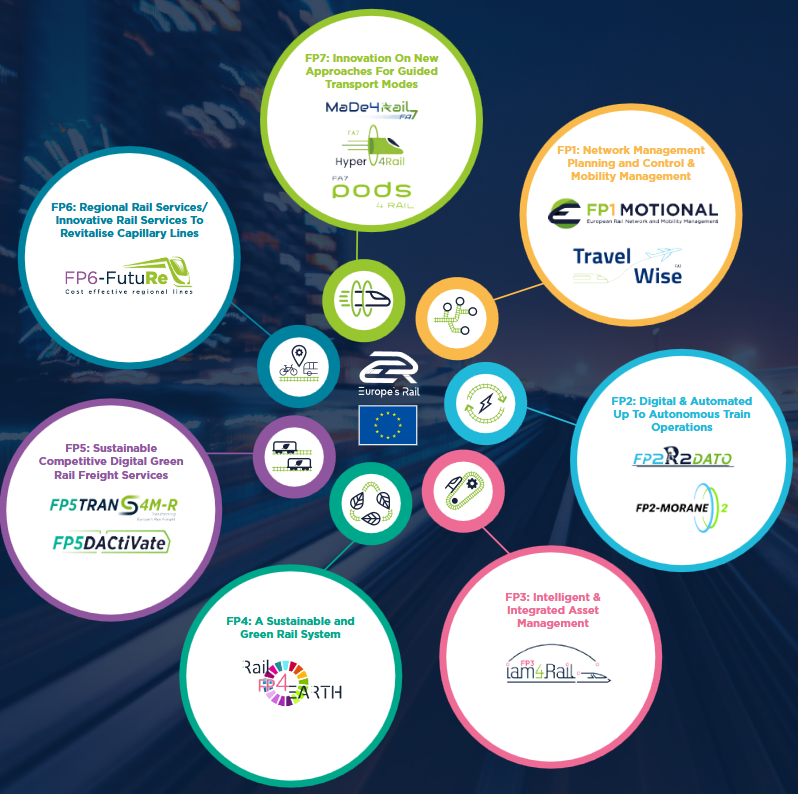
Discover detailed information on Europe's rail innovation initiatives, showcasing flagship and other projects aimed at enhancing rail systems across Europe. It highlights collaborative efforts funded by the European Union to develop sustainable, efficient, and competitive rail transport solutions.
It showcases successful research and innovation results, highlighting their potential as market-ready solutions and the benefits they offer to rail stakeholders. It also emphasises how integrating demonstrators into market solutions can drive future rail innovation capabilities.

Europe’s Rail Joint Undertaking (EU-Rail) is the European partnership on rail research and innovation established under the Horizon Europe programme (2020-2027) and the universal successor of the Shift2Rail Joint Undertaking.

Find out the full list of Europe's Rail Members.

Discover the full structure and governance of Europe's Rail, including the decisions of the Governing Board.
Get access to Europe's Rail main reference documents, including Annual Work Plans, Annual Activity Reports, Annual Accounts and other important information.
This document constitutes “Deliverable 3.3 Digital/Data reference system architecture FDFT” of ER JU Flagship Area 5 project FP5-TRANS4M-R. This document reports results from task 3.2 FDFT reference system architecture.
The objective of this document is to provide the Digital/Data reference system architecture and requirements based on deliverable D3.1 Functional system architecture FDFT and D3.2 Physical Reference System Architecture, in conjunction with the deliverable D2.2 User requirements of WP2 of ER JU FP5 TRANS4M-R. The Digital/Data reference system architecture will define the basis for the development of the innovations for WP5WP12. It describes the target of full automation of the freight sector, as well as a subset based on the agreed technical enablers in FP5-TRANS4M-R.
The Digital/Data architectural requirements are followed by the Digital/Data reference system architecture including an overview as well as the logical blocks required in FDFT traction units and FDFT wagons. To allow un-restrained innovations to be used, when designing the technical enablers in FP5-TRANS4M-R, the document focusses at the Digital/Data related requirements in an open way, as much as possible.
This document constitutes “Deliverable 3.2 Physical reference system architecture FDFT” of ER JU Flagship Area 5 project FP5-TRANS4M-R. This document reports results from Task 3.3: Specification of physical and data reference system architecture.
The objective of this document is to provide the physical reference system architecture and requirements based on deliverable D3.1 Functional system architecture FDFT in conjunction with deliverable D2.2 User requirements of WP2 of ER JU FP5 TRANS4M-R. The physical system architecture will define the basis for the development of the innovations for WP5-WP12. It describes the target of full automation of the freight sector, as well as a subset based on the agreed technical enablers in FP5-TRANS4M-R.
The physical requirements are followed by the Physical reference system architecture including an overview as well as the physical blocks required in FDFT traction units and FDFT wagons. To allow un-restrained innovations to be used, when designing the technical enablers in FP5-TRANS4M-R, the document focusses at the physical requirements in an open way, as much as possible.
This document constitutes “Deliverable 3.1 System Requirements Specification FDFT” of ER JU Flagship Area 5 project FP5-TRANS4M-R. This document reports results from task 3.2 Train reference system architecture.
The objective of this document is to provide the functional system requirements based on the target operational procedures laid down in deliverable 2.1 “Preliminary Operational Procedures” of task 2.1 of ER JU FP5 TRANS4M-R. The functional system architecture will define the basis for the development of the innovations for WP5-WP12. It describes the target of full automation of the freight sector, as well as a subset based on the agreed technical enablers in FP5-TRANS4M-R.
The section Objective / Aim explains how WP3 intensively aligned the various aspects derived from the target operational procedures within the project.
At the centre of this document, are the Functional System Requirements derived from the deliverable 2.1 Preliminary Operational Procedures, describing what is necessary to operate the Fully Digital Freight Train in Europe. The functional requirements are added to the process descriptions as additional attributes, which have been kept unedited for consistency and ease of reading.
The functional requirements are followed by the Functional reference system architecture including an overview as well as the functional blocks required in FDFT traction units and FDFT wagons. To allow un-restrained innovations to be used, when designing the technical enablers in FP5-TRANS4M-R, the document focusses at the pure functional requirements, wherever possible.
Rail freight transport faces significant challenges like asset utilization, poor data quality or complex processes. To cope with these challenges, changes are required. Automatization and digitalization play a crucial role in enhancing the competitiveness of rail freight. The vision of future freight transport involves an intelligent system that interconnects various stakeholders, processes, and technologies. However, due to the close interdependence in European rail freight transport and since the full digital freight train (FDFT) and its ecosystem is not compatible with today’s systems, only a harmonized approach on European level will be successful.
To tackle these challenges, the project Flagship Project FP5 – TRANS4M-R was initiated. TRANS4M-R is a consortium project that is part of Europe’s Rail Joint Undertaking (ERJU) and is funded within Flagship Area 5 with a duration from 2022 to 2026. The project aims to boost innovation for the European rail freight sector, concretely by developing, validating, and demonstrating TRANS4M-R technical enablers.
This document constitutes Deliverable 2.3 Reference Freight System Architecture of ERJU Flagship Area 5 project FP5 TRANS4M-R and is aimed at providing an overall functional reference freight system architecture by combining different subsystems into one. For FP5 – TRANS4M-R, these subsystems comprise the FDFT, yard automation systems, innovative freight assets as well as seamless operation. The developed architecture describes the target of full automation of the freight sector, as well as a subset based on the agreed technical enablers in TRANS4M-R.
The reference freight system architecture is compiled by the different partners of this task 2.3. Complementary to the work packages involved, this work focuses on the interfaces of the different subsystems, their interaction, and the resulting impacts on the overall systems. Accordingly, the level of detail presented within this document is on an aggregated level. For details on the subsystem architectures please refer to the deliverables of the respective work packages (WP3, WP4, WP5, WP6-WP12, WP25, WP26-WP31). The alignment process of WP2 on the reference freight system architecture is described in the methodology section of this document.
According to its delivery date early in the project, the aim of this report is to describe and define an overall architecture that is highly modular to leave enough space for future developments within the course of TRANS4M-R. The interfaces between the different subsystems are defined accordingly and the overall architecture is described at a high level. The architecture needs to be detailed out in upcoming deliverables of the different subsystems. This report therefore does not describe a fully detailed overall architecture.
The developed architecture provides an important basis for further collaboration on the development of an automatized and digitalized freight rail operation, especially within FP5-TRANS4M-R. In the further course of FP5-TRANS4M-R, the reference architecture will be applied enabling its further refinement in FP5 TRANS4M-R. Lead by the interoperability and modularity principles, further adjustments, and enhancements at later stages of the migration, i.e., roll-out scenarios, will be possible. The functional reference freight system architectures will serve as foundation for authorisation of FDFTO, Seamless Freight vision and yard automation technologies and procedures. In addition to this deliverable, the architecture will be provided as a separate model for better usability.
This document constitutes deliverable D2.2 “User-Requirements” of EU-Rail Flagship Area 5 project FP5 TRANS4M-R. The project aims to boost innovation for the European rail freight sector, concretely by developing, validating, and demonstrating FP5- TRANS4M-R technical enablers. The reports results from task 2.4: Functional requirements.
The primary objective of this document is to provide the functional User-Requirements that are needed to perform the processes described in deliverable D2.1 “Preliminary Operational Procedures”. These requirements form the foundation for innovation development across WP3-WP12.
To derive the functional requirements from the operational procedures in chapter 6 – Elaboration of Requirements a methodology was developed that ensures the completeness and allows iterations including other WPs and expert groups. Polarion is the tool that is used within FP5 for requirements management in general. Therefore, all User-Requirements are created, developed, evaluated, and approved within this tool. Moreover, experts from various WPs were involved and decisions would be documented transparently and fully traceable. The developed methodology enables system and subsystem requirements that are to be developed in other WPs at different timelines to link to the User-Requirements and form relations.
The scope and delimitations of this document are stated in chapter 7 – General Assumptions & Premises. As the base of the elaborated User-Requirements are the Operational Procedures in D2.1, the restrictions stated there are also valid for this document. Within D2.1 the target Operational Procedures are used as reference to derive the User-Requirements from them.
In addition, further influencing factors were identified in chapter 8 which require the definition of further User-Requirements by other WPs or expert groups. These must be taken into account in a future overall consideration of the functional requirements of the FDFT system. Beyond the task description, non-functional User-Requirements and requirements resulting from other influencing factors are partly included in this deliverable when indicated without claim of completeness.
The results are to be found as User-Requirements and User-Features that are hierarchically and thematically related to each other. Items resulting from the operational procedures are divided into cluster that describe the following topics: System in General, DAC System, Power System, Data System and Brake System. They can be found in chapter 9 – User-Requirements.
The results represent the current state of discussions within FP5 TRANS4M-R based on the Target Operational Procedures. The currently elaborated User-Requirements state a work in progress that still needs to be consolidated and verified within the evaluation and verification/validation process in Polarion. Due to continuous development within the requirements management process in Polarion, future releases of D2.1, or other developments within the project it is intended that these requirements are subject to possible changes in further development and will most likely be adapted in the future. Consequently, this document will then be updated and updated versions will be published.
This document constitutes Deliverable 2.1 Preliminary Operational Procedures of ER JU Flagship Area 5 project FP5-TRANS4M-R. The document reports results from task 2.1 Target operational procedure description. The project aims to boost innovation for the European rail freight sector, concretely by developing, validating and demonstrating FP5-TRANS4M-R technical enablers. The objective of this document is to provide the first agreed throughout Europe target operational procedures for rail freight. The procedures will define the basis for the development of the innovations for WP3-WP12. It describes the target of full automation of the freight sector, as well as a subset based on the agreed technical enablers in FP5-TRANS4M-R. The section Methodology explains how WP2 intensively aligned the various version of the target operational procedures within the project, as well as within the sector. Sections General Assumptions and Premises as well as Definitions lay the foundation to understand the framework under which the processes must be read. At the centre of this document are the Target Operational Procedures, describing unified processes how to operate the Full Digital Freight Train in Europe. The detailed processes are accompanied by detailed process descriptions. These are followed by a special version of the target procedures focusing on the to be delivered technical enablers in FP5-TRANS4M-R.
Rail freight transport faces a number of challenges, such as a lack of network capacity and productivity. Rail transport must use new digital technologies to meet the needs of customers. The Flagship Project FP5 – TRANS4M-R was launched to cope with these challenges. TRANS4M-R, a consortium project of the Europe’s Rail Joint Undertaking EU-Rail JU) and funded within Flagship Area 5 of the Innovation Pillar, for a period from 2022 to 2026, will develop, validate, and demonstrate TRANS4M-R technical enablers (TE).
This document constitutes Deliverable 1.5 “First KPI Report” of FP5 TRANS4M-R and provides an estimation of how the technical enablers of the project will impact the Key Performance Indicators (KPI), given in the Multi Annual Work Programme and further detailed out in the Grant Agreement of FP5 TRANS4M-R. To this aim, the relevant KPIs are first described in this deliverable for the project. Second, the methodology to map the KPIs to the different technical enablers is described. In the main part of this document, reference values are summarized which provide the basis for comparison for future improvements. These numbers consider the railway system of the years 2024 as baseline. It is important to concretely specify the measuring process of these reference values since future improvements can only be compared based on the same process.
Based on these considerations, future improvements given as the impact of the technical enablers on improved KPIs are estimated. The presented KPI estimations reflect the target state of full digitization. The results shown in this deliverable give a first indication on which effects could be expected in the future. The presented values will be monitored continuously and validated in lab and field tests. For a harmonized approach, a strong collaboration with the work packages (WPs) on cost-benefit-analyses (WP19) and test planning and execution (WP13-WP18, WP20, WP21, WP24, WP33 and WP34) is crucial. A way of collaboration was set-up during the process of writing this deliverable.
In the target process, a significant improvement compared to the baseline will be enabled by the technical enablers developed in FP5 TRANS4M-R. The estimated benefits presented in this document focus on non-disruptive processes. However, the technical enablers probably also will increase robustness of the processes at hand further improving the KPI on average. An assessment of the impact of an increased robustness on the KPI will only be possible in commercial use with a broad data base to reach a statistically valid assessment.