On 24-25 November, the Europe's Rail General Assembly 2026 took place, providing an opportunity to review the...
Europe’s Rail General Assembly 2026
read more

A body of the
European Union

Access the list of all EU-Rail Calls for Proposals.

On 21 June 2024, the Governing Board of Europe’s Rail Joint Undertaking (EU-Rail) adopted a Call for Expression of Interest (CEI) with a view to selecting associated members with the potential to contribute to the achievement of its objectives. The Governing Board decision can be accessed here.
Discover detailed information about procurment rules and information.
Access detailed information about past tenders.

Europe's Rail regularly published Calls for Tenders. To find out about open Calls, follow link below.
Article 15 (Principle of transparency) of the EU-Rail financial rules states that the JU shall make available on its internet site no later than 30 June of the following financial year information on the recipients of funds deriving from its budget.
EU-Rail’s Innovation Pillar (IP) is tasked to deliver operational and technological solutions that contribute to a more efficient, flexible, and demand-led, yet safe and environmentally sustainable European railway system.
The System Pillar provides governance, resource, and outputs to support a coherent and coordinated approach to the evolution of the rail system and the development of the system view.

The Deployment Group advises the EU-Rail Governing Board on the market uptake of rail innovation developments and support their deployment.
For a successful and effective implementation of the Digital Automatic Coupler for European rail freight (DAC), it is of crucial importance to have open, close and efficient cooperation between rail stakeholders. The European DAC Delivery Programme enabled by Europe’s Rail, offers a unique European platform for such cooperation and collaboration.
Discover how Europe’s Rail Joint Undertaking is calling for a bold, coordinated investment strategy to simplify and modernise rail systems across the EU. This public-private partnership model – outlined in our High-Level Paper – proposes an €18 billion investment from 2028 to 2034 to strengthen European competitiveness, deliver greener transport, and drive technological sovereignty.

The Shift2Rail Joint Undertaking is the predecessor programme of the Europe's Rail Joint Undertaking (EU-Rail), established by Council Regulation (EU) 2021/2085 of 19 November 2021.
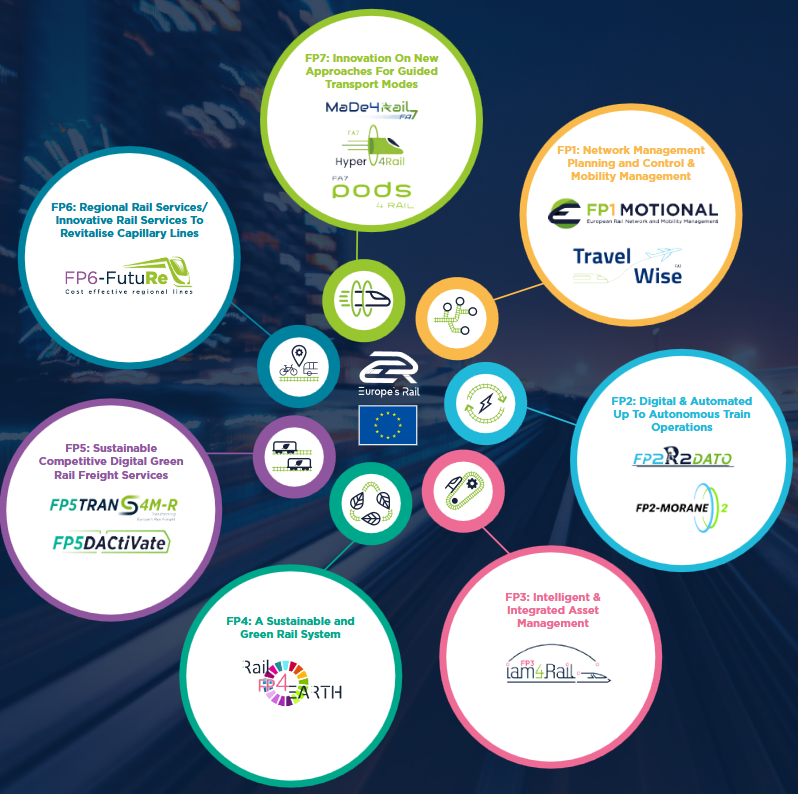
Discover detailed information on Europe's rail innovation initiatives, showcasing flagship and other projects aimed at enhancing rail systems across Europe. It highlights collaborative efforts funded by the European Union to develop sustainable, efficient, and competitive rail transport solutions.
It showcases successful research and innovation results, highlighting their potential as market-ready solutions and the benefits they offer to rail stakeholders. It also emphasises how integrating demonstrators into market solutions can drive future rail innovation capabilities.
Europe’s Rail Joint Undertaking (EU-Rail) is the European partnership on rail research and innovation established under the Horizon Europe programme (2020-2027) and the universal successor of the Shift2Rail Joint Undertaking.

Find out the full list of Europe's Rail Members.

Discover the full structure and governance of Europe's Rail, including the decisions of the Governing Board.
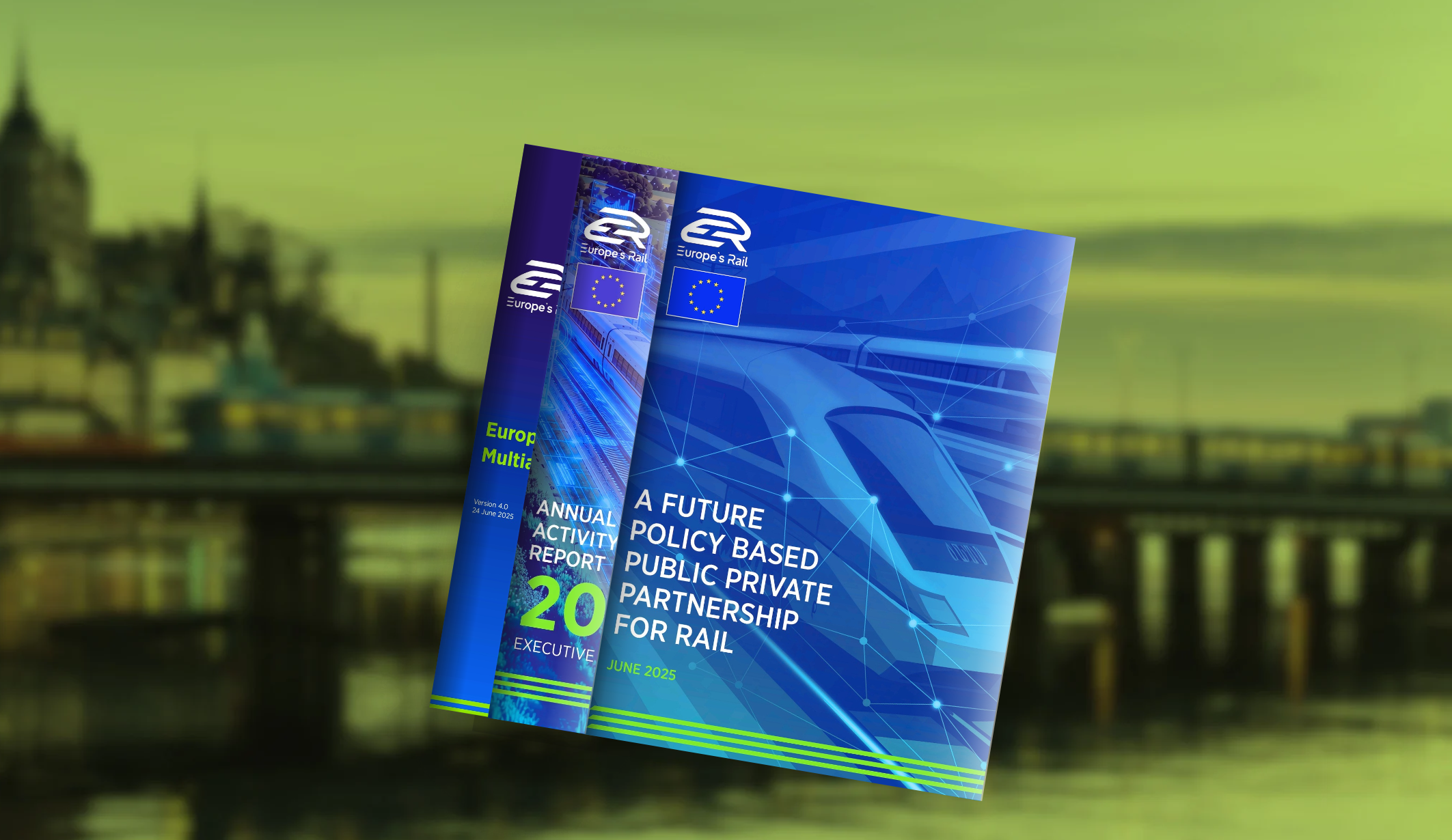
Get access to Europe's Rail main reference documents, including Annual Work Plans, Annual Activity Reports, Annual Accounts and other important information.
Title: Building the Federated Rail Data Space: Sandbox, Metadata Broker, App Store & Connectors (D31.1, D31.2, D31.3 & D31.4)
Deliverables D31.1, D31.2, D31.3 and D31.4 establish the technical foundation of the Federated Rail Data Space within FP1-MOTIONAL. Aligned with the European Data Strategy, GAIA-X and International Data Spaces (IDSA) standards, they define and implement a secure, decentralised environment that enables railway stakeholders to share and use data while retaining control of their assets. The four components are:
D31.1 Sandbox Environment: Defines and implements a ready-to-run minimum viable dataspace based on the open-source Eclipse Dataspace Components (EDC). Hosted through T-Systems’ Living Lab and an extension environment at FS Technology, it allows partners to develop, test and validate rail-specific extensions and governance rules.
D31.2 Decentralised Metadata Broker & Discovery Services: Specifies and demonstrates a federated catalogue based on EDC, the Dataspace Protocol (DSP), DCAT, JSON-LD and ODRL. It enables organisations to publish descriptions of their data resources and usage policies, allowing authorised users to discover available resources before contract negotiations.
D31.3 IDSA-Compliant App Store: Presents the tmOS Marketplace, developed by TMC, which allows users to browse data offers, initiate contract negotiations, transfer data securely and access analytical services such as Digital Twin models.
D31.4 IDSA-Compliant Connectors: Evaluates and validates EDC-based connectors that link organisations’ internal systems to the federated data space. They support decentralised identity verification (DIDs and Verifiable Credentials), automated contract negotiation and policy-controlled data transfers. The complete solution was successfully demonstrated and validated at TRL 6 using railway predictive maintenance and train positioning use cases.
How it brings us closer to achieving better rail for Europe: These deliverables establish the basis for secure data sharing and interoperability across the railway sector.
Target audience: Rail stakeholders, Member States, Policymakers
More information on these topics: FP1-MOTIONAL
D23.1 Demonstration Plans for Improving Passenger Experience and Passenger Flow
Deliverable D23.1 presents the demonstration plans developed within WP23 of the FP1-MOTIONAL project. The work focuses on improving passenger experience and operational management through solutions supporting Persons with Reduced Mobility (PRM), hands-free travel and improved passenger flow and guidance on platforms. The deliverable defines the use cases, testing strategies and timelines for setting up and carrying out the demonstrations. It also outlines the expected outcomes and risk management strategies. The demonstrations are organised across four European cities: Madrid, Málaga, Amsterdam and Berlin, with each location focusing on specific Technical Enablers (TEs 20, 21 and 22). The solutions, covering Technology Readiness Levels (TRLs) 4 to 8, will be assessed in terms of their integration into existing infrastructure, usability and effectiveness.
How it brings us closer to achieving better rail for Europe: The plans prepare the testing of solutions for more accessible and passenger-friendly rail services across Europe.
Target audience: Rail stakeholders, Member States, policymakers.
D23.2 Services for Inclusive Rail-based Mobility: Demonstration Results
Deliverable D23.2 presents the implementation, validation and evaluation of the demonstrations carried out within WP23 of the FP1-MOTIONAL project. Addressing Technical Enablers TE20 (Travel Assistance Across Modes), TE21 (Hands-free Solutions) and TE22 (Platform-based Guidance), the work focuses on improving accessibility, passenger guidance and the travel experience. The demonstrations cover the following solutions:
How it brings us closer to achieving better rail for Europe: The solutions improve accessibility, passenger guidance and boarding safety across the European rail network.
Target audience: Rail stakeholders, Member States, policymakers.
More information on this topics: FP1-MOTIONAL
D32.5 DATO capacity and impact simulations report
FP2-R2DATO (Rail to Digital automated up to autonomous train operation) investigates how digital and automated train operation can improve railway capacity and operational performance. This report develops a theoretical interface matrix linking changes in train traffic behaviour, across ten capacity building blocks and four capacity indicators, to fourteen economic and financial Business Case (BuCa) value indicators, categorised by stakeholder. It then establishes tailored interface matrices for specific DATO technologies, including ATO (GoA2 and GoA4), ETCS Hybrid Train Detection (HTD), New Generation Braking (NG Brake), C-DAS, Traffic Management Systems (TMS) and Digital Automatic Coupling (DAC). Finally, these matrices are applied to microscopic railway capacity simulation results from five real-world use cases in the Netherlands and Sweden to assess the operational, economic and societal impacts of these technologies.
How it brings us closer to achieving better rail for Europe: By linking railway capacity simulations to economic and financial impacts, this report helps stakeholders assess the benefits of DATO technologies and make informed investment decisions.
Target audience: Rail stakeholders, Member States, policymakers.
D39.6 Analysis of Automatic Driving benefits in energy saving
FP2-R2DATO (Rail to Digital automated up to autonomous train operation) investigates the operational and sustainability benefits of automated train operation. This report evaluates the energy consumption and operational performance of Automatic Driving compared to manual driving. It establishes a KPI-based evaluation framework covering running time adherence, onboard electrical energy consumption, braking events and Automatic Train Protection (ATP) interactions. The analysis considers both macroscopic and section-level microscopic perspectives and uses operational data from commercial passenger services on Italy’s Empoli–Siena regional line, operated with HTR312/412 Blues trains, complemented by controlled test runs at the San Donato test site. The results show average energy savings of 15% to 22% in this line, depending on the running direction, alongside smoother speed profiles, more predictable timetable adherence and fewer corrective braking actions. No ATP alerts or interventions were recorded during the Automatic Driving runs. The results provide operational evidence of the technology’s performance at TRL 6–7.
How it brings us closer to achieving better rail for Europe: By demonstrating energy savings of up to 22% using real operational data from the Empoli-Siena regional line, this report supports the development and deployment of more energy-efficient automated train operation.
Target audience: Rail stakeholders, Member States, policymakers.
More information on this topics: FP2-R2DATO