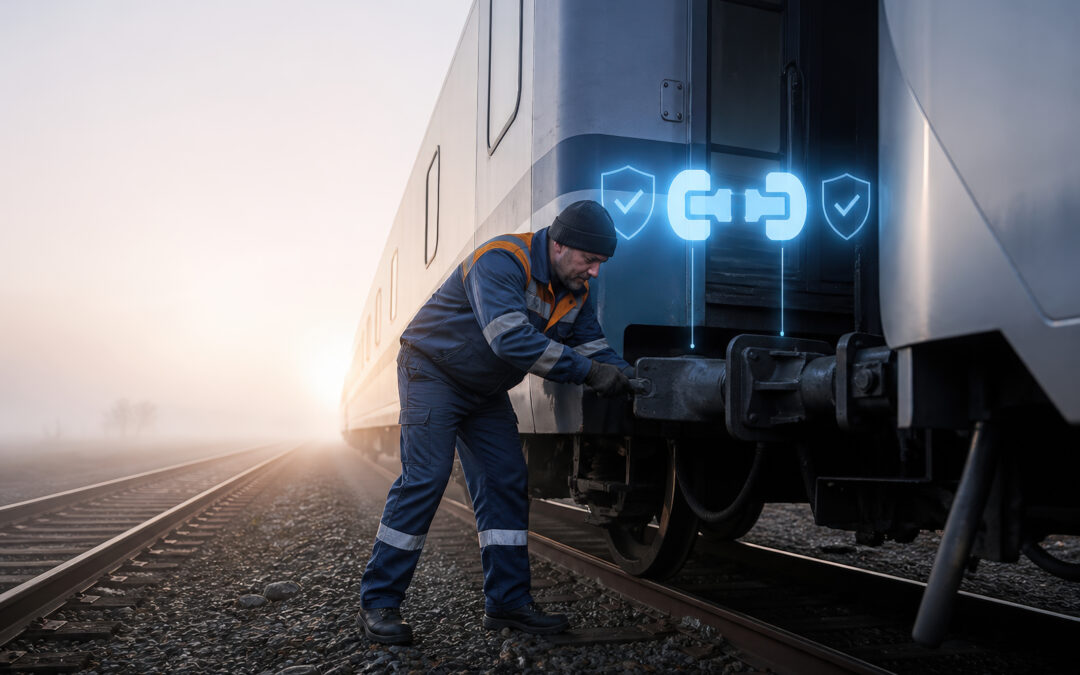
Pods4Rail D10.1 Concept development for equipment of sample vessel Pods4Rail develops a modular, autonomous transport...
Deliverables: Results Published in October 2026
read more


A body of the
European Union

Access the list of all EU-Rail Calls for Proposals.

On 21 June 2024, the Governing Board of Europe’s Rail Joint Undertaking (EU-Rail) adopted a Call for Expression of Interest (CEI) with a view to selecting associated members with the potential to contribute to the achievement of its objectives. The Governing Board decision can be accessed here.
Discover detailed information about procurment rules and information.
Access detailed information about past tenders.

Europe's Rail regularly published Calls for Tenders. To find out about open Calls, follow link below.
Article 15 (Principle of transparency) of the EU-Rail financial rules states that the JU shall make available on its internet site no later than 30 June of the following financial year information on the recipients of funds deriving from its budget.

EU-Rail’s Innovation Pillar (IP) is tasked to deliver operational and technological solutions that contribute to a more efficient, flexible, and demand-led, yet safe and environmentally sustainable European railway system.

The System Pillar provides governance, resource, and outputs to support a coherent and coordinated approach to the evolution of the rail system and the development of the system view.

The Deployment Group advises the EU-Rail Governing Board on the market uptake of rail innovation developments and support their deployment.
For a successful and effective implementation of the Digital Automatic Coupler for European rail freight (DAC), it is of crucial importance to have open, close and efficient cooperation between rail stakeholders. The European DAC Delivery Programme enabled by Europe’s Rail, offers a unique European platform for such cooperation and collaboration.

Discover how Europe’s Rail Joint Undertaking is calling for a bold, coordinated investment strategy to simplify and modernise rail systems across the EU. This public-private partnership model – outlined in our High-Level Paper – proposes an €18 billion investment from 2028 to 2034 to strengthen European competitiveness, deliver greener transport, and drive technological sovereignty.

The Shift2Rail Joint Undertaking is the predecessor programme of the Europe's Rail Joint Undertaking (EU-Rail), established by Council Regulation (EU) 2021/2085 of 19 November 2021.
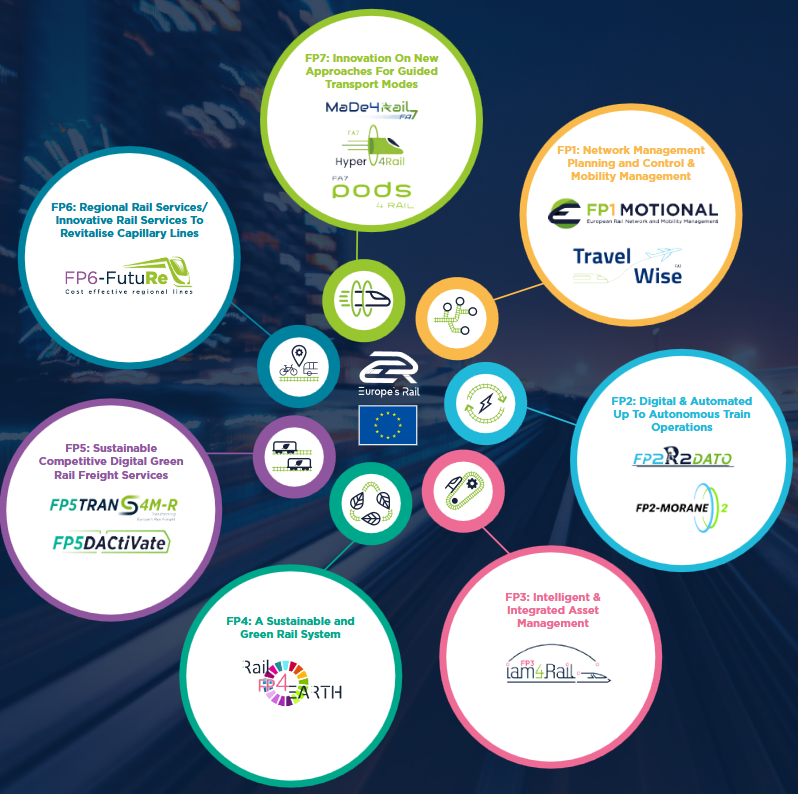
Discover detailed information on Europe's rail innovation initiatives, showcasing flagship and other projects aimed at enhancing rail systems across Europe. It highlights collaborative efforts funded by the European Union to develop sustainable, efficient, and competitive rail transport solutions.
It showcases successful research and innovation results, highlighting their potential as market-ready solutions and the benefits they offer to rail stakeholders. It also emphasises how integrating demonstrators into market solutions can drive future rail innovation capabilities.
Europe’s Rail Joint Undertaking (EU-Rail) is the European partnership on rail research and innovation established under the Horizon Europe programme (2020-2027) and the universal successor of the Shift2Rail Joint Undertaking.

Find out the full list of Europe's Rail Members.

Discover the full structure and governance of Europe's Rail, including the decisions of the Governing Board.
Get access to Europe's Rail main reference documents, including Annual Work Plans, Annual Activity Reports, Annual Accounts and other important information.
Deliverable 2.5 “Use Cases for project demonstrations”” provides the description of the 163 Use Cases to be demonstrated in 76 demonstrations planned in the FP1 MOTIONAL project. The results of these upcoming demonstrations will be provided in separate demonstration reports.
The purpose of Deliverable 2.4 “Demonstration Strategy” is to present a strategy, the guidelines and templates for the preparation and delivery of demonstrations planned in the second half of the FP1-MOTIONAL project ( Month 25 – Month 43).
The document explains the structure of demonstration phase ( four sub-phases: Specifications, Implementation, Execution and Evaluation) and provides the important elements of the selected demonstrations. The document also describes the interactions between Workstream 1 and Workstream 2 of FP1-MOTIONAL, as well as the collaboration with other Flagship Projects needed to support the delivery of the entire demonstration phase for the project.
This document forms Deliverable 2.3 “Use Cases for planned technical developments of the project” of FP1 MOTIONAL Project. It is designed to present the new technical Use Cases proposed by the MOTIONAL project. The report also includes an analysis of data availability in prototype environments. The deliverable contains 160 Use Cases (UCs) covering all technical activities within MOTIONAL Work Packages (WPs). These Use Cases reflect the project tasks in form of a story between the actors and the MOTIONAL platforms. The use cases will be used to design the proposed solutions and later on development reports they can be used to validate that the technical developments were able to fulfil the initially defined goals.
The purpose of this document is to present a Workplan for collaboration with other EU-RAIL Destinations for Flagship Project 1: MOTIONAL. The Workplan outlines the objectives, guidelines, collaboration activities, deliverables, outcomes and risk management strategies for the collaboration between Flagship Project 1 and the other participating EU-RAIL Destinations. The objectives of collaboration include improving knowledge sharing, enhancing collaboration and coordination, and increasing efficiency and effectiveness of technical enablers developed by the Flagship projects. The guidelines for collaboration address communication and coordination mechanisms, roles and responsibilities, data sharing and confidentiality, intellectual property rights, and timelines and milestones. The activities include identifying potential collaboration, joint planning and implementation of pilots, and documentation exchange. Overall, this Workplan aims to establish a successful and productive collaboration between Flagship Project 1 and the other EU-RAIL Destinations, with the aim to provide better results in all involved projects. This document was updated after the first FP1 Maturity Checkpoint, considering comments from EU-Rail and other Destinations.
Deliverable 1.3: “First Report on KPI Achievements and Impact” provides an overview of the first assessment (expert judgement) of the Key Performance Indicators (KPIs) and Performance Indicators (PIs) undertaken at the end of the development phase within the FP1-MOTIONAL project .
This report leverages the KPI assessment methodologies previously detailed in deliverable D1.2 – Description of metrics and methodology. A structured process for expert selection and a general questionnaire were employed to gather feedback on the appropriateness of methodologies and progress towards KPI goals. The document highlights challenges encountered, such as the debate over baseline dates, chosen methodologies and the roadmap to 2030. The report also addresses the project’s alignment with five of the seven impact areas defined in the Master Plan, including enhancing sustainability, meeting evolving customer requirements, and reinforcing the role of rail in European transport.
This document constitutes the Deliverable D3.1 “Mapping against scope, specification of technical enablers, high-level use cases, high-level requirements, high-level design for demonstrators in WPs 4-9” in the framework of the Flagship Project FP1-MOTIONAL.
The objective of this deliverable is to align, prepare and deliver the high-level specifications of requirements, high-level design, and high-level use cases for the development of the technical enablers 1 to 7. The high-level specification is done in parallel with more detailed specifications from WP4, WP6 and WP8. Participants from all WPs contributed to the texts.
In the project proposal, seven technical enablers were linked to Workstream 1.1 (Planning work packages), i.e., WP4/WP5 (Integration of Planning Systems and Processes), WP6/WP7 (Decision Support and Optimization) and WP8/WP9 (Simulation and Operational feedback). Here, each of the technical enablers are described in detail, including alignment with previous results, current state of practice, assigned development needs and high-level requirements.
An extensive mapping is also a result that is presented in this deliverable. All demonstrators (that further on will be called demonstrations) in Workstream 1.1 are introduced and described, together with related use cases. There are 13 demonstrations and they are all mapped against technical enablers, TRL levels, use cases and the high-level requirements defined for each technical enabler. They are also mapped against simulation environments and frameworks to be used within WP4/WP5, WP6/WP7 and WP8/WP9. Finally, the alignment and interactions between WP4-WP9 demonstrations and other FA1 WPs, other Flagship Projects and SP Task 3 CMS/TMS and RNE are mapped.
This document identifies the Key Performance Indicators from Europe’s Rail Joint Undertaking’s Multi Annual Workplan that are relevant to FP1-MOTIONAL and the associated Performance indicators (PIs) to be reached by the end of the project, in 2026. The document also describes the proposed methodologies to measure these by comparing established 2022 baselines with the results of the relevant demonstrations or expert judgements to be delivered later in the project. Other impacts of the project, including: societal, economical, technological and scientific, and political impacts are also assessed in this deliverable.
The usage of latest digital technologies (e.g. federated data spaces, CDM, digital twins, etc.) are key enablers to drive the railway industry forward and are mainly responsible for almost any optimization within the last years. That is why FP1-MOTIONAL Work Stream 2 (Work packages 26-31) is focused on the investigation of new technologies as well as the adoption of existing ones that are available on the market to enable these for the railway community; so, called: “technical enablers”.
Since, this approach would remain ineffective until these technical enablers are not used in combination with a use case, WP26 is obliged to technically enable as many use cases as possible, that evolve from the other flagship projects. However, only those use cases shall be cooperated with, where’s use case owner are requesting for that sort of support. The usage of WP26 technical enablers is not mandatory to any use case owner.
Main goal of this first task within WP26 (26.1) was to come to a common understanding of how the required use cases that evolve from the other flagship projects shall be identified and interacted with. This interaction shall include the identification of use cases as mentioned above, that envisage the usage of at least one technical enabler technology developed in workstream 2 FP1-MOTIONAL. Furthermore, it shall set relevant stakeholders (namely use case owners and owners of technical enablers) into contact with each other to join forces within an iterative process, where the use cases and the technical enablers are combined step by step to research on it’s synergies and effectiveness (Task 26.2). Finally, the outcome of this investigation shall be to come to a consensus of how the set of use cases shall be collected and documented (Task 26.3).
For this purpose, the WP26 working group developed a process within task 26.1 on basis of the “swim lane” methodology that maps all stakeholders and their respective tasks within the use case collection process execution. The process description covers the identification of relevant use cases, the collection of them and – if applicable – their adoption by the System Pillar towards standardization.
This process as well as the common understanding are considered the main outcome of this task and are described in this document.
The present document examines how a harmonized set of data can be used to realize the idea of SERA and a Single European Railway Traffic Management system. This vision is based on the concept that a common data model can be used in the supply chain, regardless of the specific domain. The System Pillar CCS-TMS Data Model is a first instance of a common model fully dedicated to CCS-TMS engineering and operations. The potential utilization of such data in other domains besides signalling, such as diagnostics, maintenance, and so forth, is analysed through the presentation of a set of business cases. The business cases allow us to identify key data requirements for the WP27 digital planning toolbox and other applications. The content of this deliverable (D27.1) will be used as input for the task 27.2 to guide the extraction of selected objects from the data sources identified. The extracted objects can be used by both the toolbox and other railway applications as a result of FP1 and other FP interactions and collaborations.