Your daily round-up of Europe’s Rail highlights, straight from the floor of InnoTrans 2026! InnoTrans kicked...
EU-Rail at InnoTrans 2026 — Highlights of the Day 1 (22 September)
read more


A body of the
European Union

Access the list of all EU-Rail Calls for Proposals.

On 21 June 2024, the Governing Board of Europe’s Rail Joint Undertaking (EU-Rail) adopted a Call for Expression of Interest (CEI) with a view to selecting associated members with the potential to contribute to the achievement of its objectives. The Governing Board decision can be accessed here.
Discover detailed information about procurment rules and information.
Access detailed information about past tenders.

Europe's Rail regularly published Calls for Tenders. To find out about open Calls, follow link below.

Article 15 (Principle of transparency) of the EU-Rail financial rules states that the JU shall make available on its internet site no later than 30 June of the following financial year information on the recipients of funds deriving from its budget.

EU-Rail’s Innovation Pillar (IP) is tasked to deliver operational and technological solutions that contribute to a more efficient, flexible, and demand-led, yet safe and environmentally sustainable European railway system.

The System Pillar provides governance, resource, and outputs to support a coherent and coordinated approach to the evolution of the rail system and the development of the system view.

The Deployment Group advises the EU-Rail Governing Board on the market uptake of rail innovation developments and support their deployment.
For a successful and effective implementation of the Digital Automatic Coupler for European rail freight (DAC), it is of crucial importance to have open, close and efficient cooperation between rail stakeholders. The European DAC Delivery Programme enabled by Europe’s Rail, offers a unique European platform for such cooperation and collaboration.
Discover how Europe’s Rail Joint Undertaking is calling for a bold, coordinated investment strategy to simplify and modernise rail systems across the EU. This public-private partnership model – outlined in our High-Level Paper – proposes an €18 billion investment from 2028 to 2034 to strengthen European competitiveness, deliver greener transport, and drive technological sovereignty.

The Shift2Rail Joint Undertaking is the predecessor programme of the Europe's Rail Joint Undertaking (EU-Rail), established by Council Regulation (EU) 2021/2085 of 19 November 2021.

Discover detailed information on Europe's rail innovation initiatives, showcasing flagship and other projects aimed at enhancing rail systems across Europe. It highlights collaborative efforts funded by the European Union to develop sustainable, efficient, and competitive rail transport solutions.

Europe’s Rail Catalogue of Solutions illustrates successful R&I results in the form of possible products and solutions, while highlighting the benefits for final users, operators, infrastructure managers and/or suppliers. This publication also outlines the advantages of integrating demonstrators into market solutions so that they can deliver the rail innovation Capabilities of the future.
Europe’s Rail Joint Undertaking (EU-Rail) is the European partnership on rail research and innovation established under the Horizon Europe programme (2020-2027) and the universal successor of the Shift2Rail Joint Undertaking.

Find out the full list of Europe's Rail Members.

Discover the full structure and governance of Europe's Rail, including the decisions of the Governing Board.

Get access to Europe's Rail main reference documents, including Annual Work Plans, Annual Activity Reports, Annual Accounts and other important information.
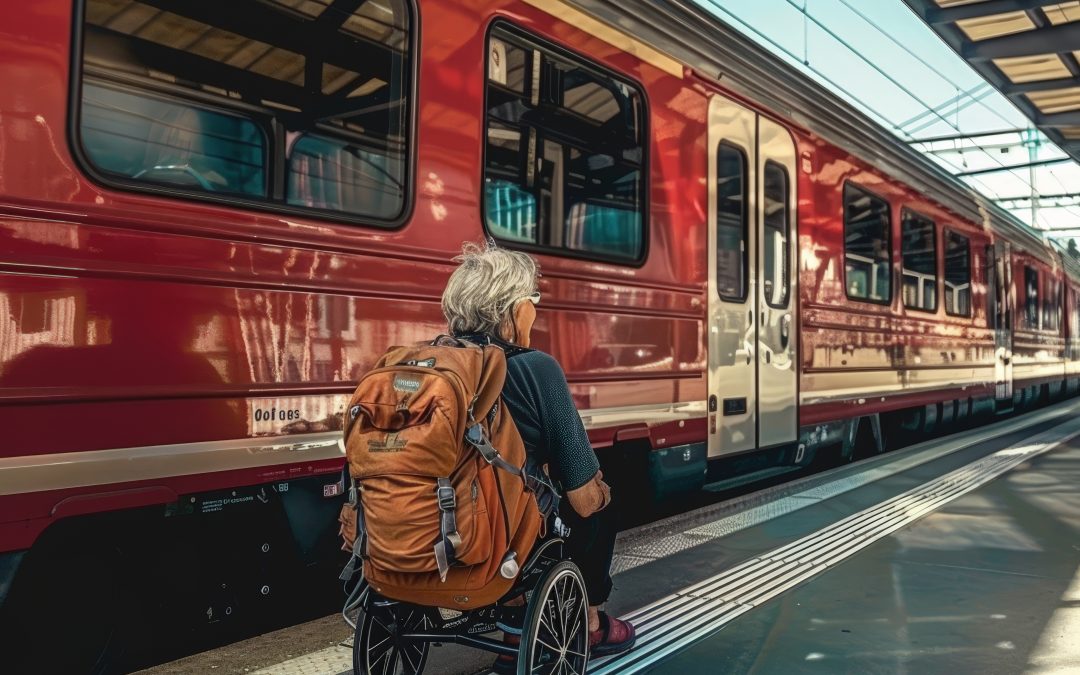
Inclusive mobility for people with disabilities is still too often overlooked, leaving many travellers unable to confidently plan and complete accessible journeys due to barriers such as unclear information, long walking distances, or unsafe boarding conditions.
To address this, two different Europe’s Rail (EU-Rail) Flagship Projects have developed a combination of real-world innovations and digital solutions:

Thanks to real world demonstrations in Málaga and Asturias, a coordinated set of technologies—from platform projections and an interactive totem to a guidance robot and an integrated software—have being tested to enhance independent travel for people with disabilities.
While in Málaga a full ecosystem of digital and physical support tools was deployed – including software, projectors, totem and robot-, Asturias test focuses on a specially engineered Gap Filler that eliminates the space between train and platform to improve safety and ease of boarding.
Together, these demonstrations demonstrate how thoughtful design and technical innovations can remove barriers and create smoother, more inclusive journeys for all passengers.
To help PMOs to easily find suitable and physically manageable travel routes, two key features for trip planner have been introduced:
These features directly address the significant barriers PRM face when planning travel, such as encountering stairs, long walking distances, or simply not having enough information to know if a route is accessible before starting their journey.
The solution on how to improve accessibility in multimodal stations is currently at the prototype stage and has already been tested with real users in practical settings and is progressing toward deployment.
Moreover, a beta version of the software functionalities on how to enhance trip planners will be fed with real world data from Saarland region (Germany) to be available along 2026 for testing by selected end-users as a part of a demonstration.
TRL 5 (Technology validated in relevant environment) and 6 (Technology demonstrated in relevant environment)
Together, these two solutions deliver significant benefits and operational impact by making public transport more accessible, efficient, and user-centred. On one hand, the deployment of physical and digital accessibility tools in stations enhances how quickly and independently travellers can access information, navigate multimodal environments, locate services, and board trains safely and smoothly.
On the other hand, the improved trip planning solution makes public transport a more viable option for people with reduced mobility by offering tailored, easy-to-use route planning through PRM profiles and optimised journeys that minimise walking distance. This not only improves user experience and reduces barriers to travel, but also helps combat social exclusion. From an operational perspective, the more flexible trip search algorithm and enhanced passenger information systems contribute to higher customer satisfaction and have the potential to increase public transport usage overall.


In conclusion, both solutions highlight how a user-centred approach to accessibility can transform public transport into a more inclusive and attractive option for all.
On one side, making information easily available and understandable, combined with thoughtfully designed station technologies, can significantly improve how travellers—especially those with disabilities—navigate, access, and safely use transport services.
At the same time, tailoring digital tools like trip planners to the specific needs of PMOs enhances their confidence and overall travel experience.
Together, these approaches not only remove barriers for users but also enable railway operators and authorities to foster social inclusion, improve customer satisfaction, and encourage a broader shift from private to public transport by serving a more diverse range of travellers.
Who Benefits

The project FP1-MOTIONAL aims to improve planning and operational management of rail services and offers to meet the European goal of making rail the preferred mode of transport.

This solution has been developed within the Europe’s Rail (EU-Rail) Flagship Project FP6-FutuRe. The project aims to ensure the long-term viability of the regional railway by reducing the total cost of ownership (TCO), while ensuring high service quality and operational reliability. It aims to increase customer satisfaction and to make rail an attractive and preferred mode of transport.