Europe’s Rail Newsletter – March Edition The March Newsletter is filled with the latest updates, key insights, and...
EU-Rail March 2026 Newsletter
read more

A body of the
European Union

Access the list of all EU-Rail Calls for Proposals.

On 21 June 2024, the Governing Board of Europe’s Rail Joint Undertaking (EU-Rail) adopted a Call for Expression of Interest (CEI) with a view to selecting associated members with the potential to contribute to the achievement of its objectives. The Governing Board decision can be accessed here.
Discover detailed information about procurment rules and information.
Access detailed information about past tenders.

Europe's Rail regularly published Calls for Tenders. To find out about open Calls, follow link below.

Article 15 (Principle of transparency) of the EU-Rail financial rules states that the JU shall make available on its internet site no later than 30 June of the following financial year information on the recipients of funds deriving from its budget.

EU-Rail’s Innovation Pillar (IP) is tasked to deliver operational and technological solutions that contribute to a more efficient, flexible, and demand-led, yet safe and environmentally sustainable European railway system.

The System Pillar provides governance, resource, and outputs to support a coherent and coordinated approach to the evolution of the rail system and the development of the system view.

The Deployment Group advises the EU-Rail Governing Board on the market uptake of rail innovation developments and support their deployment.
For a successful and effective implementation of the Digital Automatic Coupler for European rail freight (DAC), it is of crucial importance to have open, close and efficient cooperation between rail stakeholders. The European DAC Delivery Programme enabled by Europe’s Rail, offers a unique European platform for such cooperation and collaboration.
Discover how Europe’s Rail Joint Undertaking is calling for a bold, coordinated investment strategy to simplify and modernise rail systems across the EU. This public-private partnership model – outlined in our High-Level Paper – proposes an €18 billion investment from 2028 to 2034 to strengthen European competitiveness, deliver greener transport, and drive technological sovereignty.

The Shift2Rail Joint Undertaking is the predecessor programme of the Europe's Rail Joint Undertaking (EU-Rail), established by Council Regulation (EU) 2021/2085 of 19 November 2021.

Discover detailed information on Europe's rail innovation initiatives, showcasing flagship and other projects aimed at enhancing rail systems across Europe. It highlights collaborative efforts funded by the European Union to develop sustainable, efficient, and competitive rail transport solutions.

Europe’s Rail Catalogue of Solutions illustrates successful R&I results in the form of possible products and solutions, while highlighting the benefits for final users, operators, infrastructure managers and/or suppliers. This publication also outlines the advantages of integrating demonstrators into market solutions so that they can deliver the rail innovation Capabilities of the future.
Europe’s Rail Joint Undertaking (EU-Rail) is the European partnership on rail research and innovation established under the Horizon Europe programme (2020-2027) and the universal successor of the Shift2Rail Joint Undertaking.

Find out the full list of Europe's Rail Members.

Discover the full structure and governance of Europe's Rail, including the decisions of the Governing Board.

Get access to Europe's Rail main reference documents, including Annual Work Plans, Annual Activity Reports, Annual Accounts and other important information.
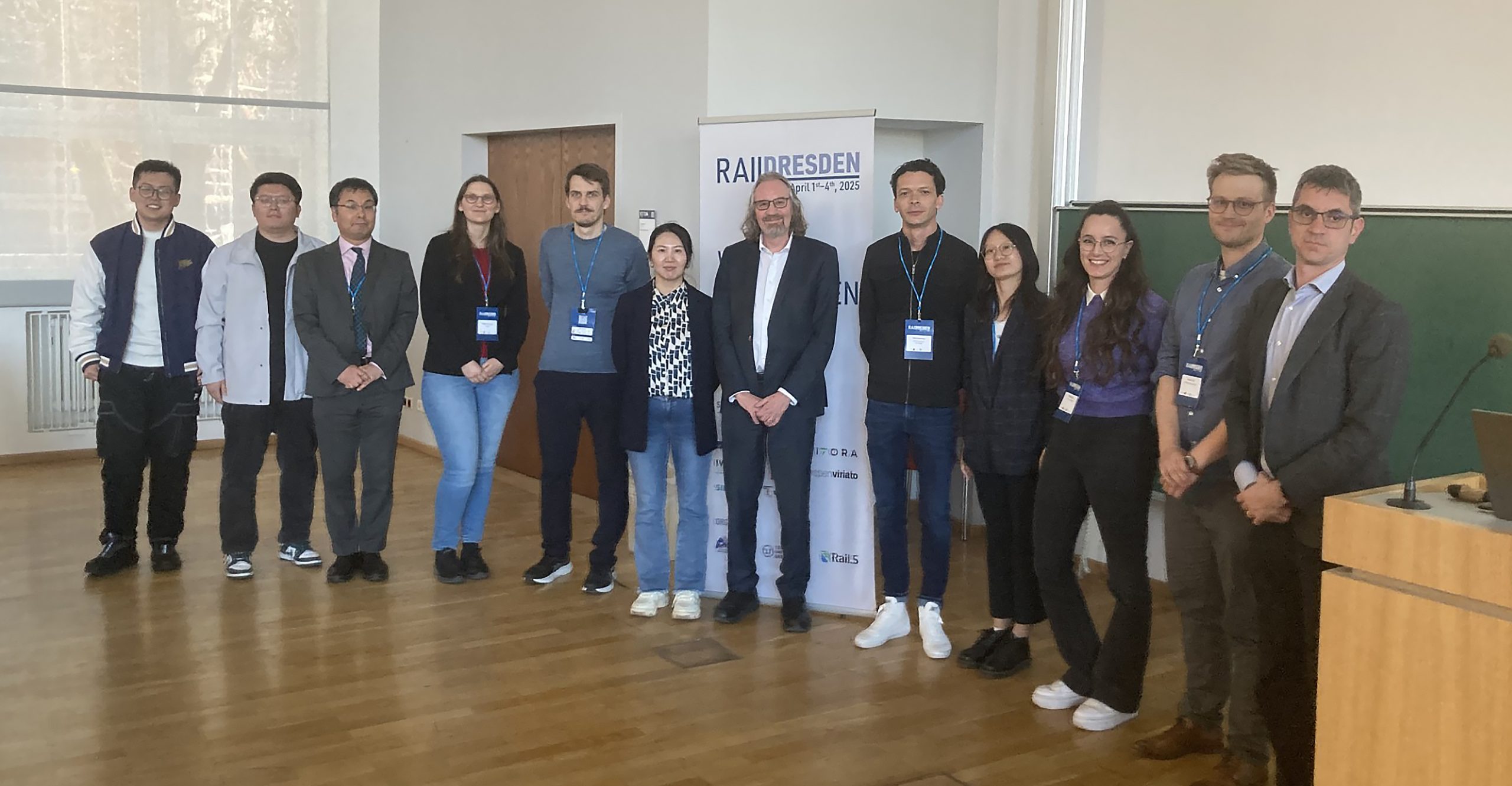
Yahan Lu, Rob Goverde, Gábor Maróti and Dennis Huisman received the Best Paper Award at the 11th International Conference on Railway Operations Modelling and Analysis (RailDresden 2025) for their paper entitled “An iterative heuristic for strategic timetabling with integrated passenger routing in railway networks”. This paper was developed under Work Package 6 of Europe’s Rail Flagship Project 1 “Motional” and was presented at RailDresden by Yahan Lu from TU Delft (fourth person from the right in the picture)
This paper presents an iterative heuristic to construct strategic timetables. Strategic timetables are used as an input for rail investments (infrastructure and rolling stock) business cases and are developed 5 – 20 years ahead, hence not all details of the disruptions due to rail infrastructure are considered. The quality of strategic timetables can be evaluated using various KPIs, depending on the aspects considered . The authors of this paper selected a KPI based on the total generalized travel time summed over all passengers, where the generalized travel time of a passenger consists of the total travel time from its origin to its destination station. It includes in-train time, the waiting time at the station and transfer times between two trains (if needed), and included a transfer penalty. The method developed in this paper proposes to use this KPI to determine the best timetable, which is a very difficult exercise from the computational perspective. However, the paper describes a heuristic method (i.e. an algorithm that is able to compute a reasonable solution in reasonable computation time) developed by the project to compute a good timetable. This solution has been tested on real-life instances of Netherlands Railways (NS) and provided good results.
For more information about the conference and the selected best papers, see https://www.iaror.org/2025/04/10/best-papers-of-raildresden-announced/