Europe’s Rail Newsletter – October Edition 📩 Discover the October Newsletter! 🚆 Explore the latest developments across...
EU-Rail October 2026 Newsletter
read more


A body of the
European Union

Access the list of all EU-Rail Calls for Proposals.

On 21 June 2024, the Governing Board of Europe’s Rail Joint Undertaking (EU-Rail) adopted a Call for Expression of Interest (CEI) with a view to selecting associated members with the potential to contribute to the achievement of its objectives. The Governing Board decision can be accessed here.
Discover detailed information about procurment rules and information.
Access detailed information about past tenders.
Europe's Rail regularly published Calls for Tenders. To find out about open Calls, follow link below.
Article 15 (Principle of transparency) of the EU-Rail financial rules states that the JU shall make available on its internet site no later than 30 June of the following financial year information on the recipients of funds deriving from its budget.

EU-Rail’s Innovation Pillar (IP) is tasked to deliver operational and technological solutions that contribute to a more efficient, flexible, and demand-led, yet safe and environmentally sustainable European railway system.

The System Pillar provides governance, resource, and outputs to support a coherent and coordinated approach to the evolution of the rail system and the development of the system view.

The Deployment Group advises the EU-Rail Governing Board on the market uptake of rail innovation developments and support their deployment.
For a successful and effective implementation of the Digital Automatic Coupler for European rail freight (DAC), it is of crucial importance to have open, close and efficient cooperation between rail stakeholders. The European DAC Delivery Programme enabled by Europe’s Rail, offers a unique European platform for such cooperation and collaboration.

Discover how Europe’s Rail Joint Undertaking is calling for a bold, coordinated investment strategy to simplify and modernise rail systems across the EU. This public-private partnership model – outlined in our High-Level Paper – proposes an €18 billion investment from 2028 to 2034 to strengthen European competitiveness, deliver greener transport, and drive technological sovereignty.

The Shift2Rail Joint Undertaking is the predecessor programme of the Europe's Rail Joint Undertaking (EU-Rail), established by Council Regulation (EU) 2021/2085 of 19 November 2021.
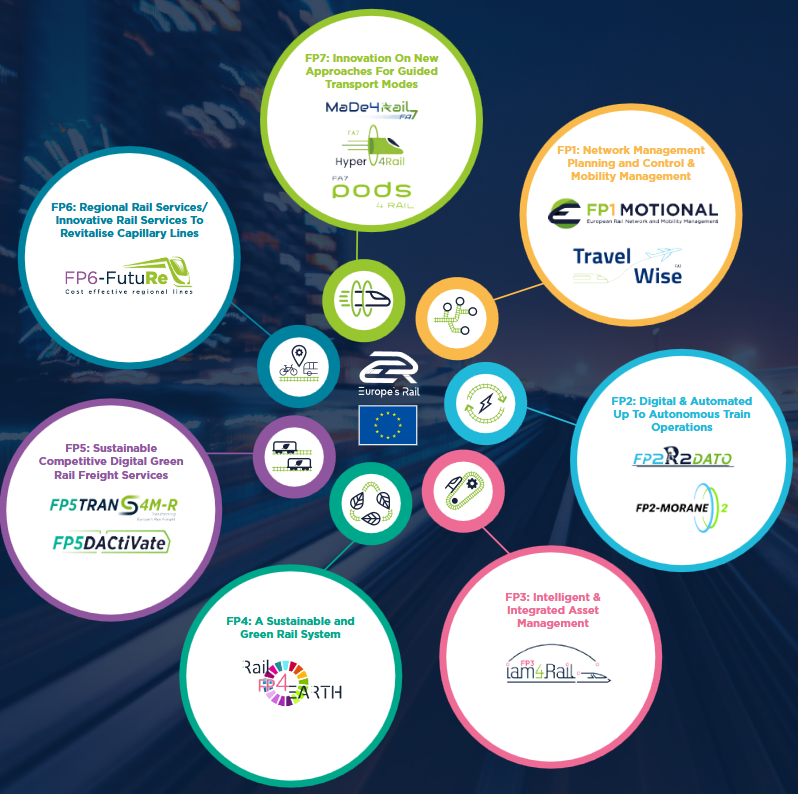
Discover detailed information on Europe's rail innovation initiatives, showcasing flagship and other projects aimed at enhancing rail systems across Europe. It highlights collaborative efforts funded by the European Union to develop sustainable, efficient, and competitive rail transport solutions.
It showcases successful research and innovation results, highlighting their potential as market-ready solutions and the benefits they offer to rail stakeholders. It also emphasises how integrating demonstrators into market solutions can drive future rail innovation capabilities.

Europe’s Rail Joint Undertaking (EU-Rail) is the European partnership on rail research and innovation established under the Horizon Europe programme (2020-2027) and the universal successor of the Shift2Rail Joint Undertaking.

Find out the full list of Europe's Rail Members.

Discover the full structure and governance of Europe's Rail, including the decisions of the Governing Board.
Get access to Europe's Rail main reference documents, including Annual Work Plans, Annual Activity Reports, Annual Accounts and other important information.
The FP6 FutuRe project, funded by Europe’s Rail Joint Undertaking, addresses the urgent need to modernize regional rail transportation and expand its operation into markets which would be marginally viable using conventional vehicles. With a focus on sustainability, efficiency, and inclusivity, the project aims to develop innovative rolling stock concepts that cater to the diverse needs of passengers, including those with reduced mobility. This deliverable, D10.1, outlines the preliminary rolling stock concept model, emphasizing mechanical design, crashworthiness, and accessibility features.
The development of the new vehicle concept began with a comprehensive analysis of existing technologies and market conditions and a derivation of the operational and functional requirements, ensuring compliance with relevant regulations and standards relevant vehicle requirements and specifications, as described in part in D5.1. Based on these results, the work described in this deliverable develops many of the mechanical, electrical and operational systems and technologies required for the vehicle.
As of today, the European railways are suffering from several systemic challenges. One of them addresses the cross-border compatibility arising from different standards and expectations from the European infrastructure managers, railway undertakings and partners from the industry. Another problem to tackle involves the competition with other modes of transport such as private car travel, and the profitability of medium route distances. Therefore, within the Flagship Project 6, a key element is to foster the collaboration among all European partners to achieve the overall objective of revitalising regional railways. It is paramount to connect regional railways with other modes of travel that are being used for first and last mile services. This enables a new competitiveness for regional railways and contributes to improved cross-border compatibility in Europe which leads to the reduction of capital expenditures and operating expenses, enhanced productivity (unit costs per train kilometre) and improved customer satisfaction. However, it is important to note that these goals are competing against each other. As a part of the Flagship Project 6, Work Package 6 deals with the conceptualisation of a multimodal travel solution providing requirement specifications. Several advancements should be introduced here, including the usage of demand-related capacity information, congestion monitoring and the utilisation of regional lines for freight transport. An orientation is provided by the technology of a Mobility-as-a-Service (MaaS) solution which aims at consolidating multiple modes of travel into a single platform. In that way, it is possible to plan journeys across all modes of transportation. The goal of Deliverable 6.9 (Task 6.8) is to specify requirements, acceptance criteria and a test strategy. To achieve this, use cases based on relevant personas using the frontend and/or backend services were identified. Important actors within the system are commuters, travellers/tourists, and persons with reduced mobility. The backend services are primarily influenced by administrators. Additionally, an analytics platform establishes a connection between business intelligence analysts and personas from infrastructure management and railway undertakings, such as the traffic manager. The prepared use cases helped with the design of the requirements questionnaire and allowed the expansion of the requirement specification by user requirements from infrastructure managers (IMs) and railway undertakings (RUs). Requirements are ranging from the interface design and user interaction to the querying of reports for insights into passenger behaviour accompanied by addressing data backup, logging of failures and redundancy of the system. Several use cases that have been documented in the deliverable potentially overlap with main line use cases. For the alpha release of the requirement specification, this is considered acceptable. During development of the final release, it will be clarified if a use case has a regional focus or if it applies to main line as well. In the latter case, synergies can be leveraged. To ensure that the implemented solutions comply with the requirement specification defined in Work Package 6, a testing strategy and respective test cases are provided.
This deliverable is developed as part of Task 6.7 within Work Package 6 (WP6) of the EU-Rail FP6 FutuRe project, a strategic initiative aimed at revitalizing regional railway networks across Europe. WP6 is dedicated to the specification phase, laying the groundwork for the solutions that will later be implemented and demonstrated by WP11. Task 6.7 aims to foster the standardization processes within the EU. It therefore identifies which data interfaces between components are necessary to provide the information which power the multimodal travel solutions designed in WP6. It analyses if standard interfaces specifications are used and if they already fulfil completely the requirements. If no standard interface specification is available, it is assessed if a standardization process for this interface is advisable. The focus was hereby put on the data exchange between different system components and therefore on data interface specifications. For task 6.7, it was envisaged that it will develop an alpha release of the final deliverable. The final version will be developed by task 11.7. During the work on the alpha release, in total six data interfaces / data formats were identified where it might be advisable to amend existing standard data specifications or create new specifications. For the final release, a more detailed gap analysis will be elaborated.
Regional railways play a crucial role in Europe, not only by serving rural areas but also by acting as feeders for passenger and freight traffic to the main network. These lines provide an essential, environmentally friendly mode of transport—regional railways enable passengers to reach remote stations and rural destinations effectively.
Given this context, the courier, express, and parcel (CEP) services industry is booming due to shifts in consumer shopping habits and increased retail activity. This growth is putting pressure on road infrastructure and local communities, highlighting the need for more sustainable freight logistics. One innovative solution is to leverage underutilized public transport, such as trams and regional trains, for freight delivery, particularly in smaller towns and rural areas. Task 6.6 within WP6 of FP6 FutuRe aims to enhance freight services to regional and rural areas by leveraging rail transport instead of road. The primary focus is to define and specify innovative solutions for integrating first and last mile transport with passenger trains. Key activities include specifying information, routing, and booking functions for cargo distribution, as well as providing transport offers based on available capacity. Furthermore, the task analyses and defines the necessary framework conditions to effectively implement these freight services.
Deliverable 6.7 outlines how to integrate cargo distribution with passenger trains, reviewing similar initiatives, operational details, and system requirements. The specifications have been described through use cases, requirements, sequence diagrams, components, functions, and interfaces and standards. These specifications are supported by a review of related projects and studies.
Despite a promising start to Task 6.6, we have been unable to secure a demonstration partner. Given this situation, continuing the project to implement and demonstrate the described functionalities to a suitable Technology Readiness Level seems unfeasible, in the subsequent demonstration in WP11.
This deliverable is developed as part of Task 6.5 within Work Package 6 (WP6) of the EU-Rail FP6 FutuRe project, a strategic initiative aimed at revitalizing regional railway networks across Europe. WP6 is dedicated to the specification phase, laying the groundwork for the solutions that will later be implemented and demonstrated by WP11. Task 6.5 emphasizes passenger congestion monitoring, providing information that enables operators and authorities to explore different scheduling approaches and adapt them to various transport services. This document specifically focuses on the passenger congestion monitoring specifications necessary to enhance the efficiency and service quality of regional railway lines. The goal of this deliverable is to create a comprehensive specification for a passenger congestion monitoring system and its associated algorithms. This system aims to enhance responsiveness to fluctuating passenger volumes in regional rail services. The structure of this deliverable includes the following key components: 1. Introduction (Section 1): A concise overview of the document’s purpose, objectives, and scope. 2. Objective/Aim (Section 2): Outlines the objectives and scope of this deliverable clearly and concisely. 3. Background (Section 3): Overview of congestion and monitoring, highlighting key challenges and current solutions. 4. Methodology (Section 4): The methodology used for the specification, focusing on the Architecture Analysis & Design Integrated Approach (ARCADIA). 5. Use Cases (Section 5): Detailed scenarios illustrating various passenger flow and congestion situations to provide practical context for system application. 6. System Requirements (Section 6): A thorough outline of both functional and non-functional requirements that the system must meet to be effective and reliable. 7. System Components (Section 7.2): Granular descriptions of each component’s functions and their alignment with system requirements, facilitating modular development and integration. 8. Exchange Scenarios (Section 7.3): Elaborated interactions between system components, depicting data flows during different operational conditions to ensure accurate and efficient data processing. 9. Algorithm Descriptions (Section 8): Specifications of algorithms designed to predict and manage passenger congestion using advanced data analytics and machine learning techniques. 10. Conclusion (Section 9): Summarizes the specifications for the passenger congestion monitoring system and its impact on regional railways. By defining these elements, this deliverable provides a robust framework for developing and implementing a passenger congestion monitoring system. This framework will guide subsequent development phases in WP11, ensuring the practical application of these specifications and thereby supporting the broader mission of the FutuRe project to revitalize regional railway networks across Europe.
The EU-Rail FP6 Future project’s Work Package 6 focuses on Regional Rail Services Requirements & Specifications, with the objective of developing and demonstrating highly accurate multimodal travel solutions for both on-board regional vehicles and at regional rail stations, for passengers and freight. Task 6.4 of WP6 focuses on providing short- and long-term travel demands using machine learning algorithms, enabling a more dynamic response to changing demand and allowing for the adjustment of planned rail services. This deliverable, “Specification of demand analysis algorithms”, is a crucial component of the project, providing specifications for demand analysis algorithms under the specific view of regional lines. This deliverable will include use cases, system actors, capabilities and requirements, high-level architecture, exchange scenarios per use case, interfaces and standards, and algorithm descriptions. The report’s purpose is to provide a comprehensive understanding of the specifications of demand analysis algorithms, ensuring that they meet the project’s objectives and requirements. The report details the scope of the work, including the partner’s developments involved, and the techniques used to develop the demand analysis algorithms. The report was developed considering also FP1 MOTIONAL project specifications on this topic, having a deep alignment on the designed solution. The main findings and conclusions of the deliverable highlight the added value of the work, particularly in overcoming the current limitations of the public transport system, which often leads to costly operations and an inability to react to changing demand. The demand analysis algorithms developed in this deliverable will enable a more dynamic response to changing demand, reducing costs and improving the overall efficiency of regional rail services.
This report encapsulates the experiences with data collection for Task 6.3 in Work Package 6 (WP6) of Flagship Project 6 FP6-FutuRe and is referred to as Deliverable 6.4. Task 6.3 involves the mapping of databases needed for various use cases within the broader context of WP6. WP6 involves specification of customer services in the context of regional rail, e.g. a multimodal travel solution including occupancy forecasts. The subsequent task corresponding to T6.3 is T11.3. The data mapping is targeted in T6.3 and the mapped data will be made available for the use case implementations in T11.3. The data on demand and supply related to railway infrastructure is required for proper conduct of operations. For example, one should know the demand and supply statistics before operating new trains or constructing new lines between two locations. The main sources of data for the supply side of railways can be identified as transport operators, infrastructure managers, and ticket vendors. Meanwhile, the demand data can be acquired from the ticket sales and passenger counts. These sources are not limited, as data on demand and supply can be generated by simulation methods, as done by researchers. Additionally, this report discusses the differences between static and dynamic data streams, focusing on their updating frequency, as well as the format and availability of these data streams. The need for data simulations and data validation is also discussed.
Deliverable 6.3 reports on the requirements and design for the interface between Traffic Management Systems (TMS) and Passenger Information Systems (PIS) in WP6 of the EU-Rail FP6 FutuRe project. The interface will be demonstrated using a PIS developed in FP6 WP6 and a TMS developed in the FP1 MOTIONAL project. The aim of the interface is twofold: On the one hand the interface facilitates to provide demand forecast data for train services from a PIS to a TMS so that on TMS side short-term traffic control actions can be taken and long-term replanning decisions can be made; on the other hand, the interface enables the TMS to send information about timetable updates via the interface to the PIS so that travellers can be informed in real time about changes impacting their journeys. The TMS-PIS interface is specified based on four use cases. Three use cases are concerned with transferring demand forecast data for regional train services from a PIS to a TMS. The demand forecast data is calculated within FP6 WP6 by an analytics component of the PIS. The demand forecasts cover (1) the number of passengers between two stations within a defined time window, (2) the number of passengers on a train between subsequent stops, and (3) the number of passenger alighting/boarding at a given station of a train service. On TMS side, the forecast data are processed and used for supporting Traffic Controllers in case of short-term demand forecasts for the next hours and Timetable/Traffic Planners in case of long-term demand forecasts for the next days. A fourth use case describes timetable updates on TMS side, such as delayed departure times or platform changes, that are transferred to the PIS.
Regional railways play a crucial role in Europe, not only by serving rural areas but also by acting as feeders
for passenger and freight traffic to the main network. These lines provide an essential, environmentally
friendly mode of transport. When combined with other public or private transportation options—such as
buses, micro-mobility services, on-demand services, cycling, walking, and driving—regional railways enable
passengers to reach remote stations and rural destinations effectively.
Ensuring the long-term viability of regional railways requires high service quality and customer satisfaction,
making rail an attractive and preferred mode of transport. Passengers rely daily on regional trains and
services for their transportation needs. To achieve and enhance customer satisfaction, reliability, and
efficiency, sophisticated information services are key. The societal importance of a smoothly running rail
service lies not only in its role as a critical infrastructure component in many European countries but also
in its contribution to sustainable living, trading, and travel.
Within FP6-FutuRe WP6, a highly accurate multimodal travel solution is developed. The goal is to deliver
transport service information for first and last mile services, while including passenger transportation and
partly combining it with freight transportation. The service information shall be supplied both on-board of
regional vehicles, e.g. via personal digital devices, and at regional rail stations. In rural areas with mostly
low density of rail services, travellers need to be able to proceed with their journey once they have reached
their final railway station.
To cater to this need, this deliverable D6.2 contains a specification of a technical solution to provide
passengers with real-time information on which mode or combination of modes is suitable to reach their
destinations. It is considered that there might be delays or other incidents that affect a transport services’
operating schedule and that some travellers may have specific mobility restrictions. Interfaces between rail
services and other mobility services, such as demand responsive transport, are helpful to adjust to different
scenarios and to operate as efficiently as possible. A possible solution is developed in collaboration of
several tasks within WP6 as well as in exchange with FP1-MOTIONAL.
The present document specifies the Final Release outline of our solution, covering the integration of
Demand Responsive Transport (DRT) in journey planning, and demand-related information for Persons with
Reduced Mobility (PRM). This document continues the initial specification of the Regional Rail Services
solution defined in D6.1, where user stories, use cases, and a high-level list of requirements were identified.
The current document builds on these use cases to derive a detailed list of requirements, sequence
diagrams, logical architecture, interfaces and standards, system components, and functionalities.
Moreover, these specifications are supported by an analytical framework, which defines the setup of an
on-demand service and includes a stakeholder analysis addressing the needs of PRM.
The specified functionalities will be developed and subsequently demonstrated in WP11, ensuring a
comprehensive and practical solution for multimodal travel for regional railways and their passengers.
Regional railways play a significant role, not only in serving rural areas in Europe, but also acting as feeders for passenger and freight traffic for the main network. Regional railway lines have an essential function as an environmentally friendly mode of transport. In combination with other public transport services, such as bus, micro mobility services, on-demand services, as well as cycling, walking, and driving, regional rail enables passengers to reach remote stations and places in rural areas. To ensure the long-term viability of regional railways, among other factors, a high service quality and high customer satisfaction are required to make rail an attractive and preferred mode of transport. Regional rail services play an important role in achieving a high customer satisfaction. Every day, passengers rely on regional trains and other regional services for transportation. The key, not only to accomplish customer satisfaction, but to also increase service quality, reliability, and efficiency, is a sophisticated information service. The societal significance of a smoothly running rail service stems not only from railways being an important part of the infrastructure in many European countries, but also from the need to live, trade and travel more sustainably. Within FP6-FutuRe WP6, a highly accurate multimodal travel solution is developed. The goal is to deliver transport service information for first and last mile services, while including passenger transportation and partly combining it with freight transportation. The service information shall be supplied both on-board of regional vehicles, e.g. via personal digital devices, and at regional rail stations. In rural areas with mostly low density of rail services, travellers need to be able to proceed with their journey once they have reached their final railway station. To cater to this need, in this deliverable D6.1, a solution is specified that can inform passengers about which mode is suitable to reach the final destinations. It is considered that there might be delays or other incidents that affect a transport services’ operating schedule and that some travellers may have specific mobility restrictions. Interfaces between rail services and other mobility services, such as demand responsive transport, are helpful to adjust to different scenarios and to operate as efficiently as possible. A possible solution is developed in collaboration of several tasks within WP6 as well as in exchange with FP1-MOTIONAL. The present document explains the Alpha Release outline of our solution, as well as the scope of collaboration with Destination 1 (FP1 -MOTIONAL). The initial specification of the Regional Rail Services solution is defined through user stories and use cases, that specify the key elements of the solution as of M6 of the project. Based on the use cases, a list of requirements has been derived, describing the requirements of the planned solution on a high level. This document is describing the first set of specifications for the solution to be developed within FP6-FutuRe WP6/11. The Final Release Specifications (D6.2) will be based on this present deliverable and will describe the solution in a more detailed way, including technical descriptions of all system functionalities and components, an architecture description, UML diagrams, and a final list of use cases and list of functionalities to be developed and subsequently demonstrated in WP11.
Group 2 Regional Lines (G2 Lines) are lines or network of lines that are not functionally/operationally connected with the mainline network (ER JU Multi Annual Work Programme and Article 1.3 (c) of the EU Interoperability Directive [8]). Group 2 regional rail is operated by passenger and/or freight services that do not enter mainline infrastructure.
G2 Lines approach is completely different from the one considered in Group 1 Regional lines (G2 Lines). While G1 lines are required to ensure interoperability within the European network, G2 lines being free from such requirement allow for a radical new approach which will be described in the document and can be summarized by the following key concepts:
1. Decouple the railway application from the telecommunication technologies.
2. Keep free the system architecture as much as possible avoiding constraining future developments.
3. Data sharing as the mean to ensure standardization and competition.
In this report, we will analyse how the above concepts match European initiatives on Satellite communications and Federated Data Spaces.
Moreover, G2 lines, apart few exceptions, are characterized by very low traffic and consequently can accommodate solutions based on not expensive technologies thanks to the less demanding operations.
This deliverable will provide, as specified in the Grant Agreement:
• A comprehensive report on requirement specification for rolling stock with a particular focus on mechanical architecture, mechanical parts, TCMS, traction/propulsion, modular interior, and train control,
• Suggestions on legislative changes/TSI updates (LOC&PAS, CCS, OPE) including operational and functional needs,
• A first concept for a lightweight, emission free rolling stock with modular interior.