Europe’s Rail Newsletter – October Edition 📩 Discover the October Newsletter! 🚆 Explore the latest developments across...
EU-Rail October 2026 Newsletter
read more


A body of the
European Union
Access the list of all EU-Rail Calls for Proposals.

On 21 June 2024, the Governing Board of Europe’s Rail Joint Undertaking (EU-Rail) adopted a Call for Expression of Interest (CEI) with a view to selecting associated members with the potential to contribute to the achievement of its objectives. The Governing Board decision can be accessed here.
Discover detailed information about procurment rules and information.
Access detailed information about past tenders.
Europe's Rail regularly published Calls for Tenders. To find out about open Calls, follow link below.
Article 15 (Principle of transparency) of the EU-Rail financial rules states that the JU shall make available on its internet site no later than 30 June of the following financial year information on the recipients of funds deriving from its budget.
EU-Rail’s Innovation Pillar (IP) is tasked to deliver operational and technological solutions that contribute to a more efficient, flexible, and demand-led, yet safe and environmentally sustainable European railway system.
The System Pillar provides governance, resource, and outputs to support a coherent and coordinated approach to the evolution of the rail system and the development of the system view.
The Deployment Group advises the EU-Rail Governing Board on the market uptake of rail innovation developments and support their deployment.
For a successful and effective implementation of the Digital Automatic Coupler for European rail freight (DAC), it is of crucial importance to have open, close and efficient cooperation between rail stakeholders. The European DAC Delivery Programme enabled by Europe’s Rail, offers a unique European platform for such cooperation and collaboration.

Discover how Europe’s Rail Joint Undertaking is calling for a bold, coordinated investment strategy to simplify and modernise rail systems across the EU. This public-private partnership model – outlined in our High-Level Paper – proposes an €18 billion investment from 2028 to 2034 to strengthen European competitiveness, deliver greener transport, and drive technological sovereignty.

The Shift2Rail Joint Undertaking is the predecessor programme of the Europe's Rail Joint Undertaking (EU-Rail), established by Council Regulation (EU) 2021/2085 of 19 November 2021.
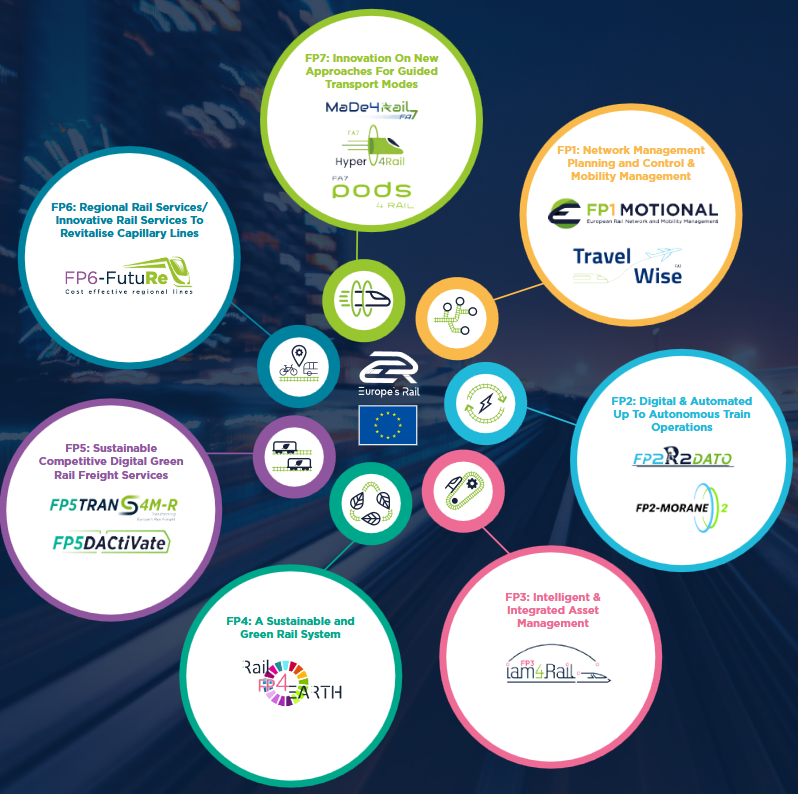
Discover detailed information on Europe's rail innovation initiatives, showcasing flagship and other projects aimed at enhancing rail systems across Europe. It highlights collaborative efforts funded by the European Union to develop sustainable, efficient, and competitive rail transport solutions.
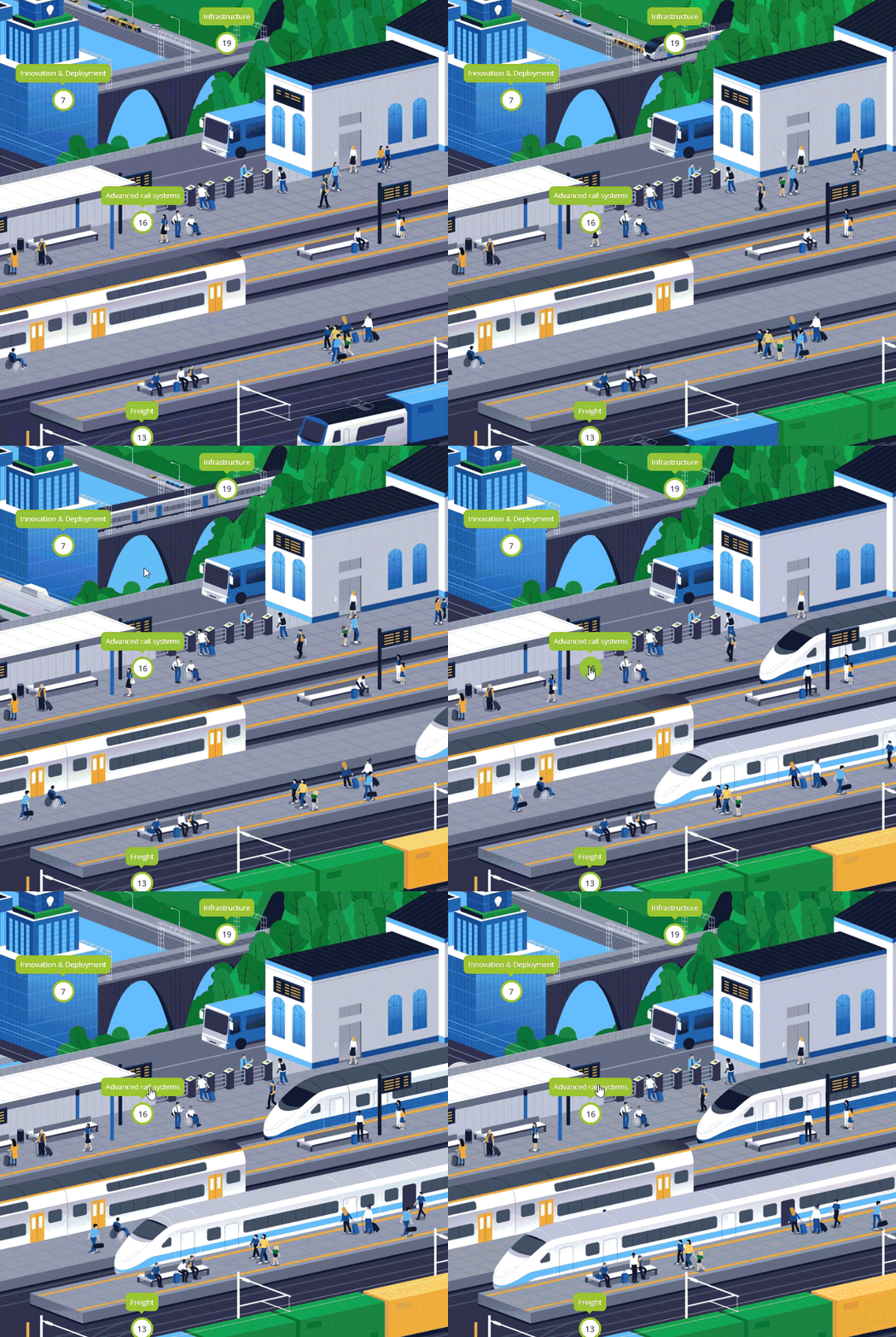
It showcases successful research and innovation results, highlighting their potential as market-ready solutions and the benefits they offer to rail stakeholders. It also emphasises how integrating demonstrators into market solutions can drive future rail innovation capabilities.
Europe’s Rail Joint Undertaking (EU-Rail) is the European partnership on rail research and innovation established under the Horizon Europe programme (2020-2027) and the universal successor of the Shift2Rail Joint Undertaking.

Find out the full list of Europe's Rail Members.

Discover the full structure and governance of Europe's Rail, including the decisions of the Governing Board.
Get access to Europe's Rail main reference documents, including Annual Work Plans, Annual Activity Reports, Annual Accounts and other important information.
This document represents “Deliverable 5.4 Technical Specification of Wagon Power System and Communication System” of the ERJU flagship project FP5-TRANS4M-R. This document reports results of task 5.5 “Technical Specification and Validation/Test Plan of the DAC Power and Data Communication solution”.
The aim of this document is to provide the requirements specification defining the interoperable system interfaces and their basic functions for the Power and Communication System on wagon side as well as on traction unit side. A basis were the recommendations and results from EDDP, which have been refined and adapted. The requirements are also based on the reference system architecture from task 3.2 and task 3.3. Additional input requirements from industry-wide stakeholders – such as TIS – were also incorporated into this requirement specification.
The requirements were developed in many technical workshops with experts. The inputs have been considered, the technical concepts were evaluated, and the result defined as requirements.
The focus of this document is the subsystem requirements. These describe what is required for the interoperable system interface and further define the basic functions of the Power System and the Communication System required to operate the Full Digital Freight Train in Europe. The chapter “Systems of interest and input requirements” explains the conditions and constraints under which the requirements to be interpreted. The chapter “Technical subsystem specification” defines the requirements applicable to Power System and Communication System.