Europe’s Rail Newsletter – September Edition The September edition of the Europe’s Rail newsletter is out! 🚆 This...
EU-Rail September 2026 Newsletter
read more


A body of the
European Union

Access the list of all EU-Rail Calls for Proposals.

On 21 June 2024, the Governing Board of Europe’s Rail Joint Undertaking (EU-Rail) adopted a Call for Expression of Interest (CEI) with a view to selecting associated members with the potential to contribute to the achievement of its objectives. The Governing Board decision can be accessed here.
Discover detailed information about procurment rules and information.
Access detailed information about past tenders.

Europe's Rail regularly published Calls for Tenders. To find out about open Calls, follow link below.

Article 15 (Principle of transparency) of the EU-Rail financial rules states that the JU shall make available on its internet site no later than 30 June of the following financial year information on the recipients of funds deriving from its budget.

EU-Rail’s Innovation Pillar (IP) is tasked to deliver operational and technological solutions that contribute to a more efficient, flexible, and demand-led, yet safe and environmentally sustainable European railway system.

The System Pillar provides governance, resource, and outputs to support a coherent and coordinated approach to the evolution of the rail system and the development of the system view.

The Deployment Group advises the EU-Rail Governing Board on the market uptake of rail innovation developments and support their deployment.
For a successful and effective implementation of the Digital Automatic Coupler for European rail freight (DAC), it is of crucial importance to have open, close and efficient cooperation between rail stakeholders. The European DAC Delivery Programme enabled by Europe’s Rail, offers a unique European platform for such cooperation and collaboration.
Discover how Europe’s Rail Joint Undertaking is calling for a bold, coordinated investment strategy to simplify and modernise rail systems across the EU. This public-private partnership model – outlined in our High-Level Paper – proposes an €18 billion investment from 2028 to 2034 to strengthen European competitiveness, deliver greener transport, and drive technological sovereignty.

The Shift2Rail Joint Undertaking is the predecessor programme of the Europe's Rail Joint Undertaking (EU-Rail), established by Council Regulation (EU) 2021/2085 of 19 November 2021.

Discover detailed information on Europe's rail innovation initiatives, showcasing flagship and other projects aimed at enhancing rail systems across Europe. It highlights collaborative efforts funded by the European Union to develop sustainable, efficient, and competitive rail transport solutions.

Europe’s Rail Catalogue of Solutions illustrates successful R&I results in the form of possible products and solutions, while highlighting the benefits for final users, operators, infrastructure managers and/or suppliers. This publication also outlines the advantages of integrating demonstrators into market solutions so that they can deliver the rail innovation Capabilities of the future.
Europe’s Rail Joint Undertaking (EU-Rail) is the European partnership on rail research and innovation established under the Horizon Europe programme (2020-2027) and the universal successor of the Shift2Rail Joint Undertaking.

Find out the full list of Europe's Rail Members.

Discover the full structure and governance of Europe's Rail, including the decisions of the Governing Board.

Get access to Europe's Rail main reference documents, including Annual Work Plans, Annual Activity Reports, Annual Accounts and other important information.
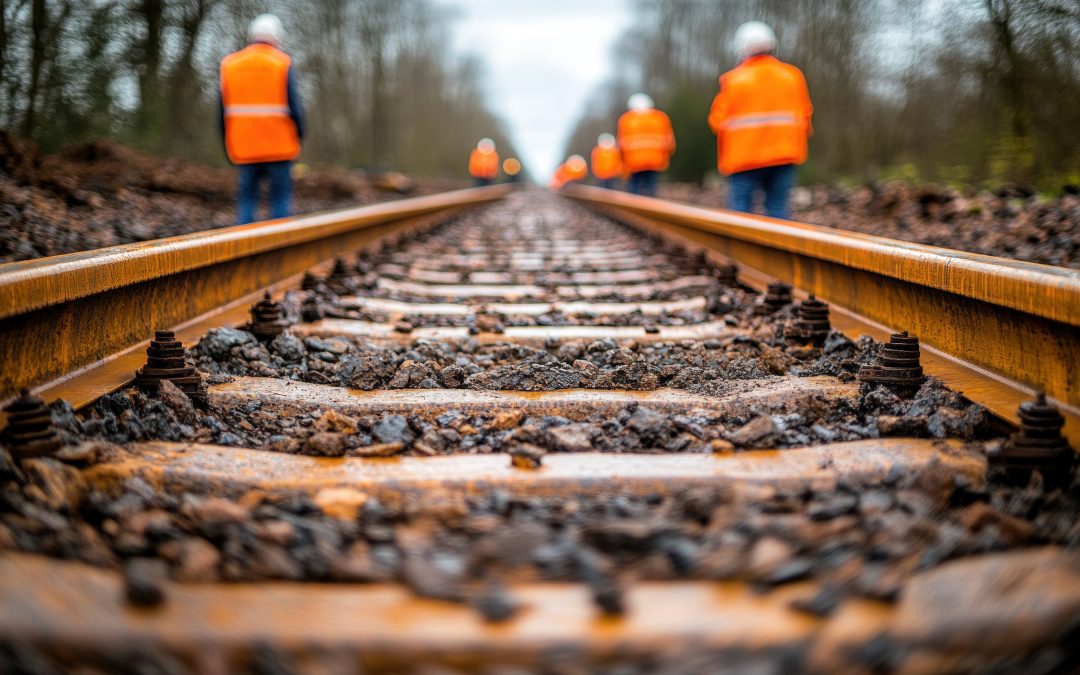
D7.3: Perform simulation with initial implementation of the Data Factory
The FP2 R2DATO project advances the digital transformation of the European rail system. The deliverable D7.3 addresses the critical need to generate synthetic sensor data through advanced simulations to support the development, testing and validation of machine learning models used in autonomous systems. The report presents the first operational implementation of the Data Factory, establishing a robust simulation framework that integrates railway information to model a variety of scenarios and to generate synthetic datasets that mirror real world conditions. It also explains how the simulation environment was built, including the creation of high fidelity 3D train models based on high resolution textures and detailed sensor configurations. Moreover, it describes the methods used to ensure realism and the configuration of sensor placements in a train. The method currently focuses on static objects and the availability of 3D assets, allowing the system to model spatial relationships accurately and detect obstacles with high precision. Consequently, the activity demonstrates that the simulation platform is capable of producing reliable and relevant synthetic data for training and testing machine learning models that are central to the development of autonomous train systems.
How it brings us closer to achieving better rail for Europe: By demonstrating how high quality synthetic sensor data can replicate both Regular Operations and Non Regular Situations , the report enables the rail sector to train and validate machine learning models without being limited by safety, cost, or data availability constraints. This accelerates the development of autonomous functions and supports future deployment by showing that advanced perception and decision making can be prepared using simulation methods aligned with operational needs as well as supporting Europe’s ambition to build a modern, digital, efficient and automated rail network.
Target audience:Rail stakeholders, Policymakers, National Safety Authorities, Notified Bodies
More information on this topic: FP2-R2DATO
D10.1: Preliminary Rolling Stock Concept model report
The FP6-FutuRe project addresses the urgent need to modernise regional rail transportation and expand its operation into markets that would otherwise be marginally viable using conventional vehicles. With a focus on sustainability, efficiency, affordability, and inclusivity, the project aims to develop innovative rolling stock concepts that cater to the diverse needs of passengers, including those with reduced mobility. This report outlines the preliminary rolling stock concept model, emphasising mechanical design, crashworthiness, and accessibility features. The development of the new vehicle concept began with a comprehensive analysis of existing technologies and market conditions and a derivation of the operational and functional requirements, ensuring compliance with relevant regulations, standards and vehicle requirements and specifications. Based on these results, the work described in this deliverable develops the mechanical, electrical and operational systems and technologies required for the vehicle.
How it brings us closer to achieving better rail for Europe: The project develops a concept tailored to regional railways and transferable across Europe. It encompasses digitalisation, automation and the use of common and new technologies for control-command and signalling, wayside components, rolling stock and customer information.
Target audience: Rail stakeholders, Member States, Policymakers
More information on this topic: FP6-FUTURE
The Pods4Rail project addresses door-to-door travel and logistics needs of customers and enhances the seamless mobility experience. This new type of sustainable collaborative transport system may emerge as a new mobility offer, diverging from the current combination of individual and mass transport services. The study presents a comprehensive business case analysis of different transportation and mobility services for pod systems. Based on selected use cases, the study covers a wide range of scenarios, from manufacturing to service deployment and analyses different business models within the public transport sector.
How it brings us closer to achieving better rail for Europe: This transport solution is expected to strengthen the position of railway transport in the future mobility market through the use of advanced technologies for automation, digitalisation and electrification.
Target audience: Rail Stakeholders, Freight operators, Researchers, End-users
More information on this topic: Pods4Rail
D5.2: Revision of the acceleration limits in bridges with ballasted tracks
The InBridge4EU project supports the improvement of railway bridge design and assessment by revisiting the acceleration limits applied to ballasted track systems. The Deliverable 5.2 presents the results of WP5 activities focused on evaluating the deck acceleration limit used in EN 1990 Annex A2 for ballasted bridges. This limit criterion for ballasted bridges is rooted in historical field observations where excessive bridge deck vibrations of 0.7 g were linked to visual ballast destabilization. This deliverable consolidates new evidence from experimental testing (i.e. shake table experiments and full-scale laboratory bridge testing) and simulation studies using the Discrete Element Method (DEM) and probabilistic assessment. The results confirm that significant increased vertical settlement occurs above acceleration levels of 0.7g, while lateral creep and reduction of the lateral resistance already occur below 0.7g. The tests also show that lateral resistance decreases with increased vertical acceleration amplitudes, and high frequency accelerations and single acceleration pulses (which occur in the non-harmonic/resonance case) should be considered for the design criteria. Overall, the results indicate that the current limit criterion of 3.5 m/s² remains appropriate when considering uncertainties, structural response and frequencies to incorporate into the calculation. The deliverable also explores the implications of reduced lateral resistance for track buckling as well as the role of vertical settlement and lateral deformations in maintenance needs. It further examines the integration of scenario-based deterministic assessment methods with probabilistic analyses to support a comprehensive re evaluation of existing design criteria aimed at improving both structural safety and cost-efficiency.
How it brings us closer to achieving better rail for Europe: The revision of the acceleration limits in bridges with ballasted tracks provides better understanding of the factors that affect ballast behaviour under vehicle loads. Based on reassessing the physical mechanisms, WP5 supports the scientific basis of European bridge design rules and contributes to a more reliable, cost efficient and interoperable rail system. The results highlight the importance of lateral resistance and vibration-induced creep under different boundary conditions and ballast parameters. This improved knowledge enables infrastructure managers, engineering companies and researchers to better distinguish between safety and maintenance related effects, allowing for more targeted mitigation measures, such as enhanced inspections or monitoring where needed. It also contributes to enhancing bridge cost-efficiency, while continuing to ensure the safety of rail operations, by supporting a stronger, more sustainable and interoperable rail network across Europe.
Target audience: Infrastructure Managers, Rail stakeholders, Member States, Policymakers, National Safety Authorities, Notified Bodies, European standardization bodies
More information on this topic: InBridge4EU
D4.2: Comprehensive metro system optimization report
The NEXUS project aims to transform metro systems by developing flexible, demand-responsive capacity, optimising train operations, and enhancing sustainability. This comprehensive metro system optimisation report presents the development of metro network and station simulation models across different simulation environments in order to compare them and build an integrated environment later in the project. It also addresses the key input parameters used in the metro station and network simulation models. The use of different simulation environments allowed the representation of complex passenger dynamics and put into perspective key aspects of metro management such as passenger flows, travel times, queue formations and passengers’ interaction with metro and platforms.
How it brings us closer to achieving better rail for Europe:Metro systems are essential to urban mobility, but they face critical challenges such as aging infrastructure, outdated control systems, and difficulty adapting to changing passenger demand. In response to these challenges, NEXUS contributes to transforming and improving European metro transportation through advanced optimisation and simulation tools.
Target audience:Urban Rail stakeholders, Member States, Policymakers
More information on this topic: NEXUS