Europe’s Rail Newsletter – September Edition The September edition of the Europe’s Rail newsletter is out! 🚆 This...
EU-Rail September 2026 Newsletter
read more


A body of the
European Union

Access the list of all EU-Rail Calls for Proposals.

On 21 June 2024, the Governing Board of Europe’s Rail Joint Undertaking (EU-Rail) adopted a Call for Expression of Interest (CEI) with a view to selecting associated members with the potential to contribute to the achievement of its objectives. The Governing Board decision can be accessed here.
Discover detailed information about procurment rules and information.
Access detailed information about past tenders.

Europe's Rail regularly published Calls for Tenders. To find out about open Calls, follow link below.

Article 15 (Principle of transparency) of the EU-Rail financial rules states that the JU shall make available on its internet site no later than 30 June of the following financial year information on the recipients of funds deriving from its budget.

EU-Rail’s Innovation Pillar (IP) is tasked to deliver operational and technological solutions that contribute to a more efficient, flexible, and demand-led, yet safe and environmentally sustainable European railway system.

The System Pillar provides governance, resource, and outputs to support a coherent and coordinated approach to the evolution of the rail system and the development of the system view.
The Deployment Group advises the EU-Rail Governing Board on the market uptake of rail innovation developments and support their deployment.
For a successful and effective implementation of the Digital Automatic Coupler for European rail freight (DAC), it is of crucial importance to have open, close and efficient cooperation between rail stakeholders. The European DAC Delivery Programme enabled by Europe’s Rail, offers a unique European platform for such cooperation and collaboration.
Discover how Europe’s Rail Joint Undertaking is calling for a bold, coordinated investment strategy to simplify and modernise rail systems across the EU. This public-private partnership model – outlined in our High-Level Paper – proposes an €18 billion investment from 2028 to 2034 to strengthen European competitiveness, deliver greener transport, and drive technological sovereignty.

The Shift2Rail Joint Undertaking is the predecessor programme of the Europe's Rail Joint Undertaking (EU-Rail), established by Council Regulation (EU) 2021/2085 of 19 November 2021.

Discover detailed information on Europe's rail innovation initiatives, showcasing flagship and other projects aimed at enhancing rail systems across Europe. It highlights collaborative efforts funded by the European Union to develop sustainable, efficient, and competitive rail transport solutions.

Europe’s Rail Catalogue of Solutions illustrates successful R&I results in the form of possible products and solutions, while highlighting the benefits for final users, operators, infrastructure managers and/or suppliers. This publication also outlines the advantages of integrating demonstrators into market solutions so that they can deliver the rail innovation Capabilities of the future.
Europe’s Rail Joint Undertaking (EU-Rail) is the European partnership on rail research and innovation established under the Horizon Europe programme (2020-2027) and the universal successor of the Shift2Rail Joint Undertaking.

Find out the full list of Europe's Rail Members.

Discover the full structure and governance of Europe's Rail, including the decisions of the Governing Board.

Get access to Europe's Rail main reference documents, including Annual Work Plans, Annual Activity Reports, Annual Accounts and other important information.
The design, construction, operation and maintenance of rail network infrastructure has to be safe, reliable, supportive of customer needs, cost-effective and sustainable. Furthermore, to deliver the benefits of market opening and interoperability and to reduce the life-cycle costs of rolling stock and on-board signalling systems, there needs to be a (gradual) elimination of network diversity through a migration towards a common high-performing infrastructure system architecture.
Infrastructure accounts for approximately one-third of the railway’s operating costs(1); EU Member States spent between EUR 29 billion and EUR 34 billion on railway infrastructure in 2012(2).
A significant part of these costs is related to labour-intensive maintenance, most of which is preventive, although ad hoc interventions are also needed when faults occur — and these can be particularly costly and disruptive. Taking into account the ageing of existing infrastructure and the expected growth in passenger and freight volumes (+ 34 % and + 40 % in 2030 respectively, compared to a 2005 baseline), shorter infrastructure access times, maintenance needs and costs are likely to increase significantly in the coming years. Therefore, Shift2Rail must first and foremost focus on activities to support the reduction of these maintenance costs (such as simplified procedures or automation), and on solutions that can be rapidly and efficiently deployed.
At the same time, many parts of existing railway infrastructure (railway lines, stations and terminals) are nearing maximum capacity or are incapable of offering users and customers the level of service they demand. There is thus a need for a step change in the productivity of infrastructure assets. These will have to be managed in a more holistic and intelligent way, using lean operational practices and smart technologies that can ultimately help improve the reliability and responsiveness of customer service, as well as the capacity and overall economics of rail transportation.
Lastly, in order to support vital pan-European rail corridors and co-modal links, and offer a smart and competitive alternative to short and medium-distance flights and water and road-borne freight flows, rail infrastructure must ensure compatibility between infrastructures (interoperable and standardised infrastructure), as well as with other modes (intermodal infrastructure, including stations and passenger and freight hubs).
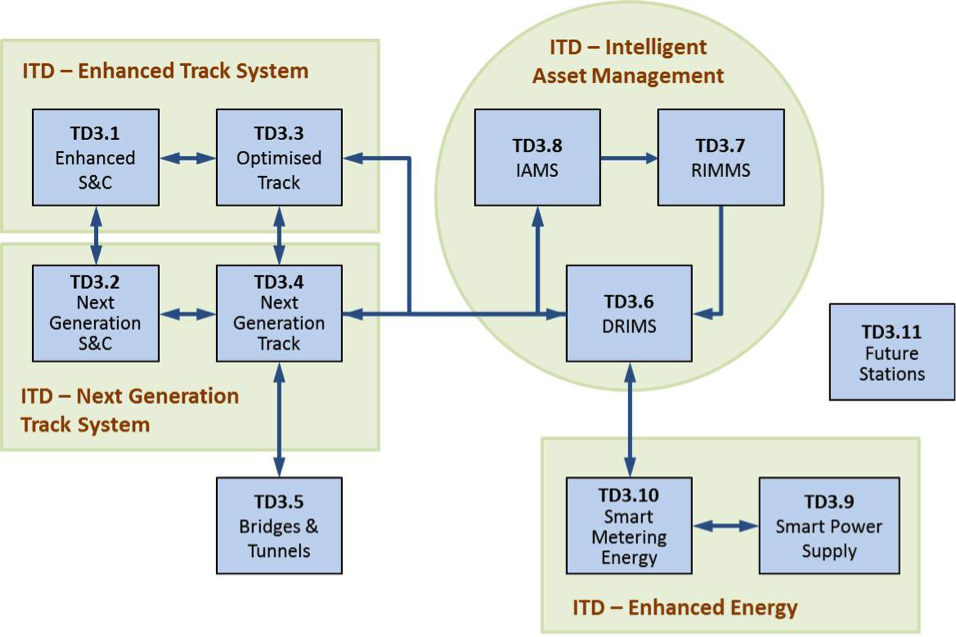
Work in IP3 will be organised around the following Technical Demonstrators (TDs) covering all R&I areas indicated in the Shift2Rail Master Plan: Enhanced Switch & Crossing System, Next-Generation Switch & Crossing System, Optimised Track System, Next Generation Track System, Proactive Bridge and Tunnel Assessment, Repair and Upgrade, Dynamic Railway Information Management System, Railway Integrated Measuring and Monitoring System, Intelligent Asset Management Strategies, Smart Power Supply, Smart Metering for Railway Distributed Energy Resource Management System and Future Stations.
The main objective of the ‘Enhanced Switch & Crossing System’ (TD 3.1) is to improve the operational performance of existing Switch & Crossing (S&C) designs through the delivery of new S&C subsystems with enhanced reliability, availability, maintainability and safety (RAMS), life-cycle costs (LCCs), sensing and monitoring capabilities, self-adjustment, noise and vibration performance, interoperability and modularity.
The ‘Next Generation Switch & Crossing System’ (TD 3.2) aims to provide radical, novel system solutions that deliver new methods for directing trains to change tracks with the aim of increasing capacity, while reducing maintenance needs, traffic disturbances and LCCs.
The ‘Optimised Track System’ (TD 3.3) will challenge track construction assumptions currently implicit in track design, and will explore how innovative solutions in the form of products, processes and procedures can provide higher levels of reliability, sustainability, capacity and LCC savings. The aim is to derive medium-term solutions, which calls for the solutions to be harmonised with current solutions and regulations.
The ‘Next-Generation Track System’ (TD 3.4) aims to drastically improve the track system, targeting a time range some 40 years beyond the present state of the art. This implies that step changes in performance are to be highly prioritised. The TD process will follow a tightly integrated chain, setting out by initially identifying the long-term needs of the railway and the potential solutions for meeting these.
The main objective of the ‘Proactive Bridge and Tunnel Assessment, Repair and Upgrade’ (TD 3.5) is to improve inspection methods and repair techniques to reduce costs, improve quality and extend their service life, if possible. Moreover, the reduction of noise and vibrations are prioritised objectives.
The ‘Dynamic Railway Information Management System (DRIMS)’ (TD 3.6) aims to define an innovative system for the management, processing and analysis of railway data. The activities in this TD will be strongly linked with the other two TDs in the area of information capturing and management. DRIMS is intended to collect information from the Railway Integrated Measuring and Monitoring System (RIMMS – TD 3.7) and to provide high-quality input to the Intelligent Asset Management Strategies (IAMS – TD 3.8).
The ‘Railway Integrated Measuring and Monitoring System (RIMMS)’ (TD 3.7) is to provide innovative tools and techniques for capturing information on the current status of assets, in a non-intrusive and fully integrated manner. To this end, the TD will focus on asset status data collection in close interaction with TD3.1 through TD3.5.
The vision of the ‘Intelligent Asset Management Strategies (IAMS)’ (TD 3.8) is a holistic, whole-system approach of asset management employing collected and processed data provided by TD3.6 and TD3.7. This includes putting long-term strategies in the context of day-to-day execution of the maintenance and other maintenance activities.
The wider objective of the ‘Smart Power Supply’ (TD 3.9) is to develop a railway power grid in an overall interconnected and communicating system.
The objective of the ‘Smart Metering for Railway Distributed Energy Resource Management System’ (TD 3.10) is to achieve a fine mapping of energy flows within the entire railway system, as the basis of any energy management strategy.
The primary objective of the ‘Future Stations’ (TD 3.11) is the provision of improved customer experience at stations. The TD is organised around four identified key functional demands: two demands relate to improving capacity and security in large stations, one demand relates to the design of small stations with the objective of reducing whole life costs and standardising design, where possible, and the final demand relates to accessibility.
The 11 TDs are strongly interrelated and they are clustered together into Integrated Technology Demonstrators (ITDs).
The ‘Indicative list of priority research and innovation activities’ in the draft Shift2Rail strategic Multi-Annual Action Plan is available in the Reference Documents > Shift2Rail JU Documents section.