The European rail community gathered on board the European Train heading to InnoTrans 2026 The European rail...
Press Release – European Train: Europe on the way to InnoTrans 2026
read more

A body of the
European Union

Access the list of all EU-Rail Calls for Proposals.

On 21 June 2024, the Governing Board of Europe’s Rail Joint Undertaking (EU-Rail) adopted a Call for Expression of Interest (CEI) with a view to selecting associated members with the potential to contribute to the achievement of its objectives. The Governing Board decision can be accessed here.
Discover detailed information about procurment rules and information.
Access detailed information about past tenders.

Europe's Rail regularly published Calls for Tenders. To find out about open Calls, follow link below.

Article 15 (Principle of transparency) of the EU-Rail financial rules states that the JU shall make available on its internet site no later than 30 June of the following financial year information on the recipients of funds deriving from its budget.

EU-Rail’s Innovation Pillar (IP) is tasked to deliver operational and technological solutions that contribute to a more efficient, flexible, and demand-led, yet safe and environmentally sustainable European railway system.

The System Pillar provides governance, resource, and outputs to support a coherent and coordinated approach to the evolution of the rail system and the development of the system view.

The Deployment Group advises the EU-Rail Governing Board on the market uptake of rail innovation developments and support their deployment.
For a successful and effective implementation of the Digital Automatic Coupler for European rail freight (DAC), it is of crucial importance to have open, close and efficient cooperation between rail stakeholders. The European DAC Delivery Programme enabled by Europe’s Rail, offers a unique European platform for such cooperation and collaboration.
Discover how Europe’s Rail Joint Undertaking is calling for a bold, coordinated investment strategy to simplify and modernise rail systems across the EU. This public-private partnership model – outlined in our High-Level Paper – proposes an €18 billion investment from 2028 to 2034 to strengthen European competitiveness, deliver greener transport, and drive technological sovereignty.

The Shift2Rail Joint Undertaking is the predecessor programme of the Europe's Rail Joint Undertaking (EU-Rail), established by Council Regulation (EU) 2021/2085 of 19 November 2021.

Discover detailed information on Europe's rail innovation initiatives, showcasing flagship and other projects aimed at enhancing rail systems across Europe. It highlights collaborative efforts funded by the European Union to develop sustainable, efficient, and competitive rail transport solutions.

Europe’s Rail Catalogue of Solutions illustrates successful R&I results in the form of possible products and solutions, while highlighting the benefits for final users, operators, infrastructure managers and/or suppliers. This publication also outlines the advantages of integrating demonstrators into market solutions so that they can deliver the rail innovation Capabilities of the future.
Europe’s Rail Joint Undertaking (EU-Rail) is the European partnership on rail research and innovation established under the Horizon Europe programme (2020-2027) and the universal successor of the Shift2Rail Joint Undertaking.

Find out the full list of Europe's Rail Members.

Discover the full structure and governance of Europe's Rail, including the decisions of the Governing Board.

Get access to Europe's Rail main reference documents, including Annual Work Plans, Annual Activity Reports, Annual Accounts and other important information.
From technical milestones to partnership highlights, the Flagship and Exploratory Projects continue to drive forward innovation in the European rail sector. Below, you will find the latest updates from January, showcasing progress, collaboration and the steps being taken toward a more integrated, sustainable and efficient rail system across Europe.
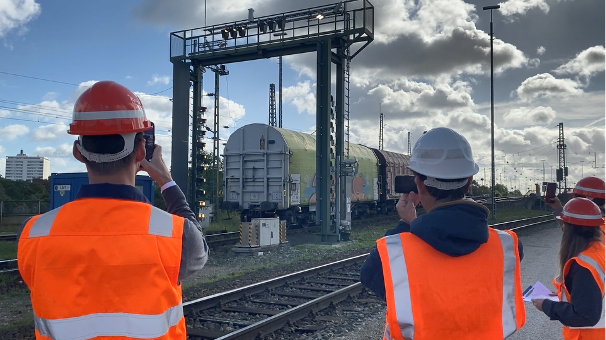
The latest EU-Rail article presents the most recent FP2-R2DATO demonstrations, showcasing progress toward Grade of Automation 4 (GoA4). Key highlights include:
The project is expected to significantly contribute to achieving the EU’s transport policy goals, including a 50% increase in rail freight and a doubling of high-speed traffic by 2030.
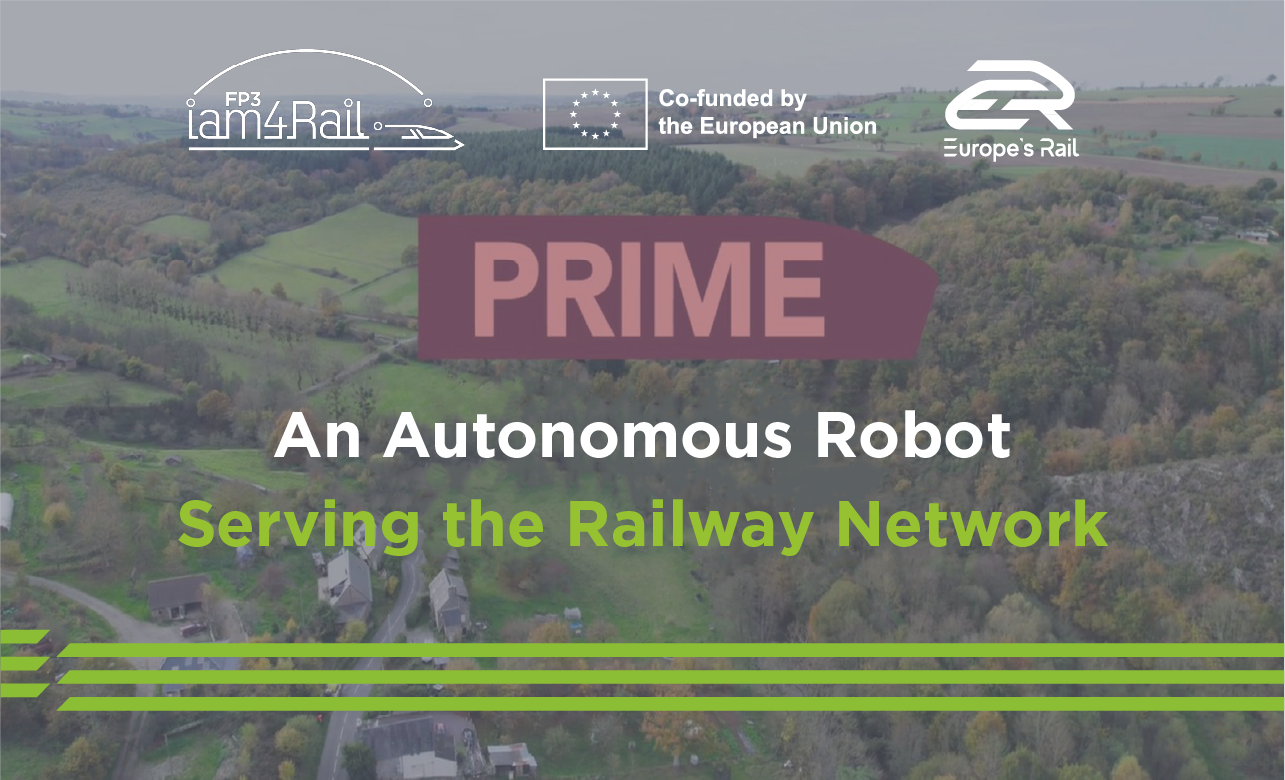
The PRIME autonomous infrastructure maintenance robot, developed during Phase 1 of our EU-Rail FP3-IAM4RAIL project by SNCF in collaboration with Trafikverket and the Norwegian Railway Directorate, is featured in a new demonstration video recorded in mid-November on the Caen – Cerisy Belle Étoile line.
The video highlights PRIME’s fully autonomous track inspection in a semi-open environment, real-time detection of static and dynamic obstacles, automatic collision prevention, on-board real-time track gauge analysis, and the ability to reverse and re-inspect at lower speed to improve data quality. The demonstration confirms PRIME’s achievement of TRL 6.
Discover the key innovations of FP3-IAM4RAIL Express project, driving the digital and technological transformation of European railways. These innovations include AI and big data platforms for predictive infrastructure maintenance, digital twin technology for station asset management, in-situ additive manufacturing, robotic inspection platforms and upper-body hybrid exoskeletons supporting railway workers.
This EU-Rail project, coordinated by ADIF and involving 29 partners, highlights the value of European collaboration in advancing railway innovation.
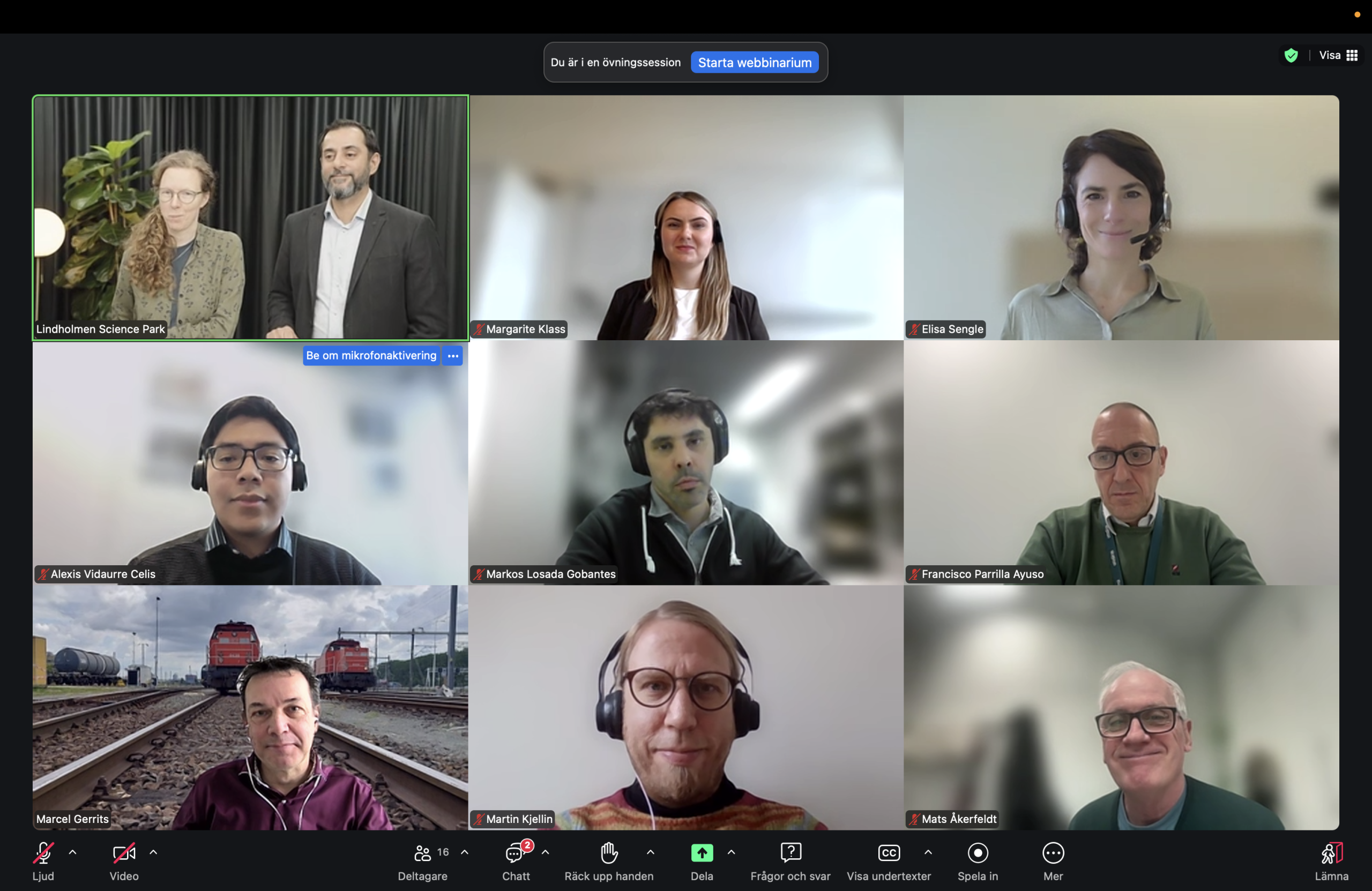
On 27 January, our EU-Rail FP5-TRANS4M-R project delivered a successful presentation on European Railway Checkpoints (ERCS) during the webinar “European Railway Checkpoints – Intelligent Monitoring of Seamless Rail Freight Transport”, which was attended by over 100 participants.
The webinar highlighted how artificial intelligence, standardised European Railway Checkpoints, and harmonised data sharing are enabling more efficient cross-border rail freight operations and supporting the future of seamless European logistics.
Four modules from Germany, Sweden, Spain, and the Netherlands were showcased, focusing on the following use cases:
The event was organised by Lindholmen Science Park, hosted by KTH Royal Institute of Technology, and included presentations from DB Cargo, Trafikverket, RISE Research Institutes of Sweden, ADIF, Indra, CEIT Centro Tecnológico, ProRail, and the University of Twente.
Our EU-RAIL FP6-FutuRe project research explores the potential of remote-control technology as an operational alternative for light regional rail vehicles.
Sweden and Norway collaborated to develop a prototype train and remote-control system with students from Linköping University. Successful demonstrations in Namsos, Norway, showed reliable control over 5 km with minimal latency and high radio redundancy.
Through these developments, FP6-FutuRe is advancing the technical maturity of remote-controlled rail systems, integrating safety measures, modern communication technologies, and operational concepts that could be introduced across Europe.
A Stakeholders’ Public Consultation of the LEADER 2030 project is open from 7 January to 28 February 2026.
The project, “LEADER 2030 – Learnings for European Autonomy to Deliver Europe’s Rail in 2030”, investigates whether Europe will have sufficient raw materials and components to bring EU-Rail innovations to market by 2030.
The consultation document provides a public-facing synthesis of evidence, trends and recommendations based on 800+ pages of research, strengthened by ongoing data collection through desk analysis, field visits, specialised workshops, online meetings and conference engagement.
Get involved:
Submit your contribution by uploading a position paper via the EU Survey platform.
Want to learn more about the project?
The LEADER 2030 research was presented at the 14th World Congress on Railway Research (Colorado Springs, USA, 17–21 November 2025). The Project Coordinator Veronica Elena Bocci presented the peer-reviewed paper “Forecast of gaps in critical supplies for Rail Innovations. A pan-European approach for resilience” during the “International Collaboration” session.
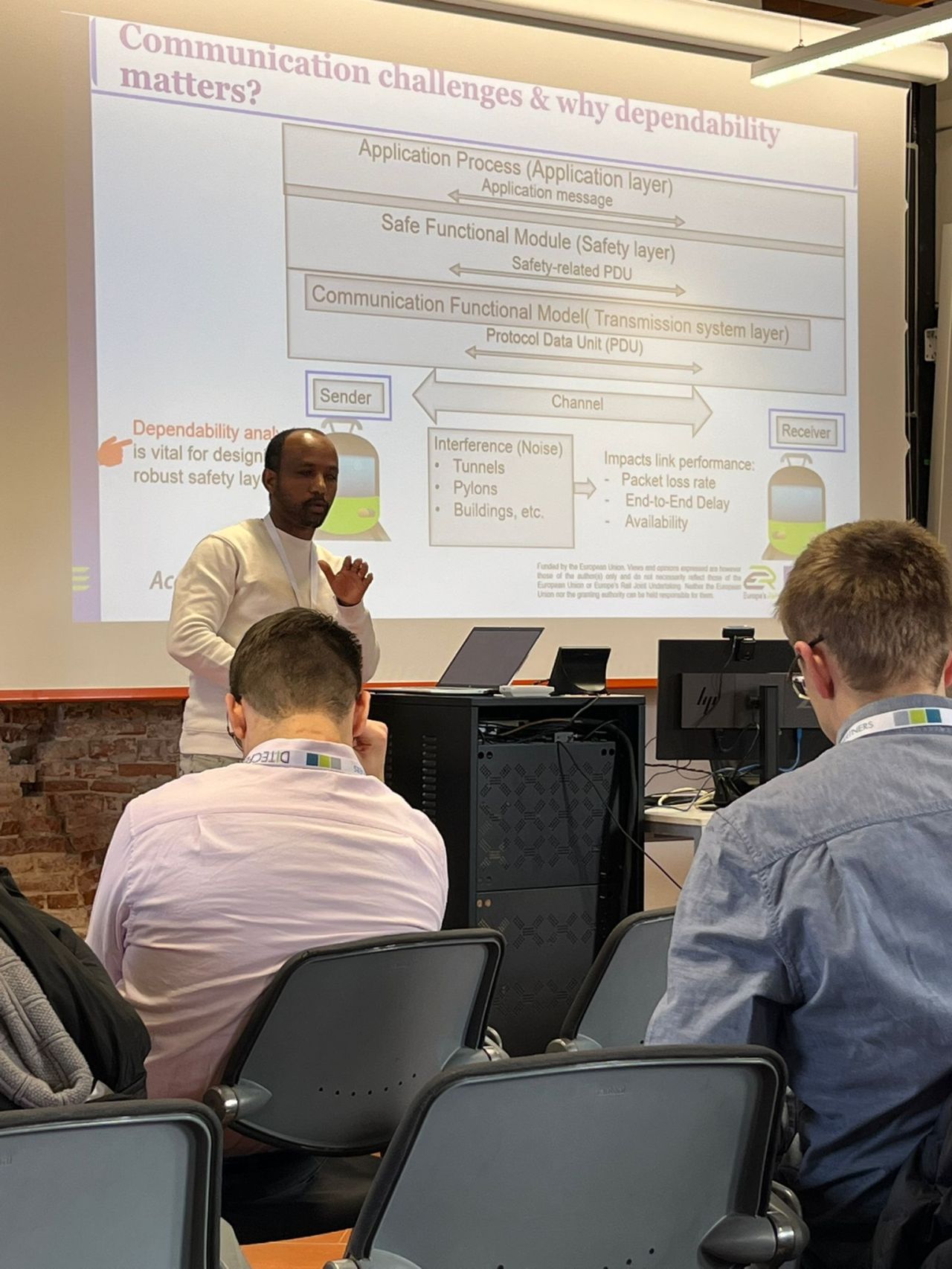
At the end of November 2025, during the 6th International Conference on Reliability, Safety, and Security of Railway Systems (RSSRail 2025), held in Pisa, Italy, Getachew Hagos Geleta from Université Gustave Eiffel presented his paper entitled “CPN-Based Modelling to Assess Dependability of Train-to-Train Wireless Communication for Virtual Coupling.”
The research, carried out within the Academics4Rail thematic area “PhD4 Digital Communications for Virtual Coupling,” was awarded the Best Student Paper Award. This achievement underlines the essential contribution of students and early-career researchers in advancing innovation and excellence in the railway sector.
The Academics4Rail project aims to build a stable and long-term scientific community, promoting knowledge exchange and collaboration with EU-RAIL and the European Rail Research Advisory Council (ERRAC).
As part of our EU-Rail SYMBIOSIS project, stakeholders working on transport infrastructure and biodiversity are invited to take part in a Learning Needs Assessment Survey.
The survey aims to identify current knowledge levels, skills gaps and learning needs, with the goal of informing future training and capacity-building activities.
It takes around 5 minutes to complete and all responses are confidential.
Deadline: 20 February
Want to learn more about the project?
Discover the new article from SYMBIOSIS titled “Changing the Scale of Perspective: From Linear, Isolated Transport Infrastructure to Sustainable Transport Networks”. The article explores how transport infrastructure can support both connectivity and nature, highlighting why biodiversity must be integrated alongside climate goals.

Our EU-Rail Pods4Rail project explores the development of a future supermodal transport system that combines the flexibility of road transport with the efficiency and sustainability of rail.
To support this work, the project has launched a stakeholder questionnaire targeting actors such as public authorities, transport operators, industry stakeholders and the research community.
The questionnaire seeks to better understand key expectations, challenges, and requirements for implementing pod-based mobility solutions in a rail setting.
It takes around 15 minutes to complete and all responses are confidential.
Deadline: 23 February 2026
Your perspective would be highly appreciated and will help ensure that the project’s results reflect real operational and policy needs.
Recently, our EU-Rail InBridge4EU project completed a large-scale reassessment based on extensive monitoring data from railway bridges across Europe. Using measurements from nearly 90 bridges in five countries, the study supports improved design assumptions, informs updates to EN 1991-2, and identifies cases where soil–structure interaction is particularly relevant, including portal frame bridges.
Beyond its direct impact on standards and design practice, the project also supports academic research. In close collaboration with InBridge4EU, Carlos Rodrigo (Universitat Jaume I) analysed how the dynamic behaviour of railway bridges influences interoperability and operational safety, identifying critical parameters for high-speed and mixed-traffic lines. This work was awarded First Prize for Best Master’s Thesis in Industrial Engineering.
Our EU-Rail NEXUS project has conducted a study to provide insight into the current and future needs of metro operators worldwide. The research focuses on three key dimensions—predictive maintenance, cybersecurity and energy consumption—essential areas for achieving operational efficiency and system resilience.
Combining literature review, survey data, and in-depth discussions with operators, the study evaluates internal processes, organisational frameworks, and innovative strategies. Its three-dimensional analysis presents a clear picture of existing practices, shared priorities, and forward-looking approaches. The results offer a global snapshot of metro operations and provide a robust foundation for guiding future projects, supporting the development of metro systems that are secure, efficient and adaptable to emerging challenges.
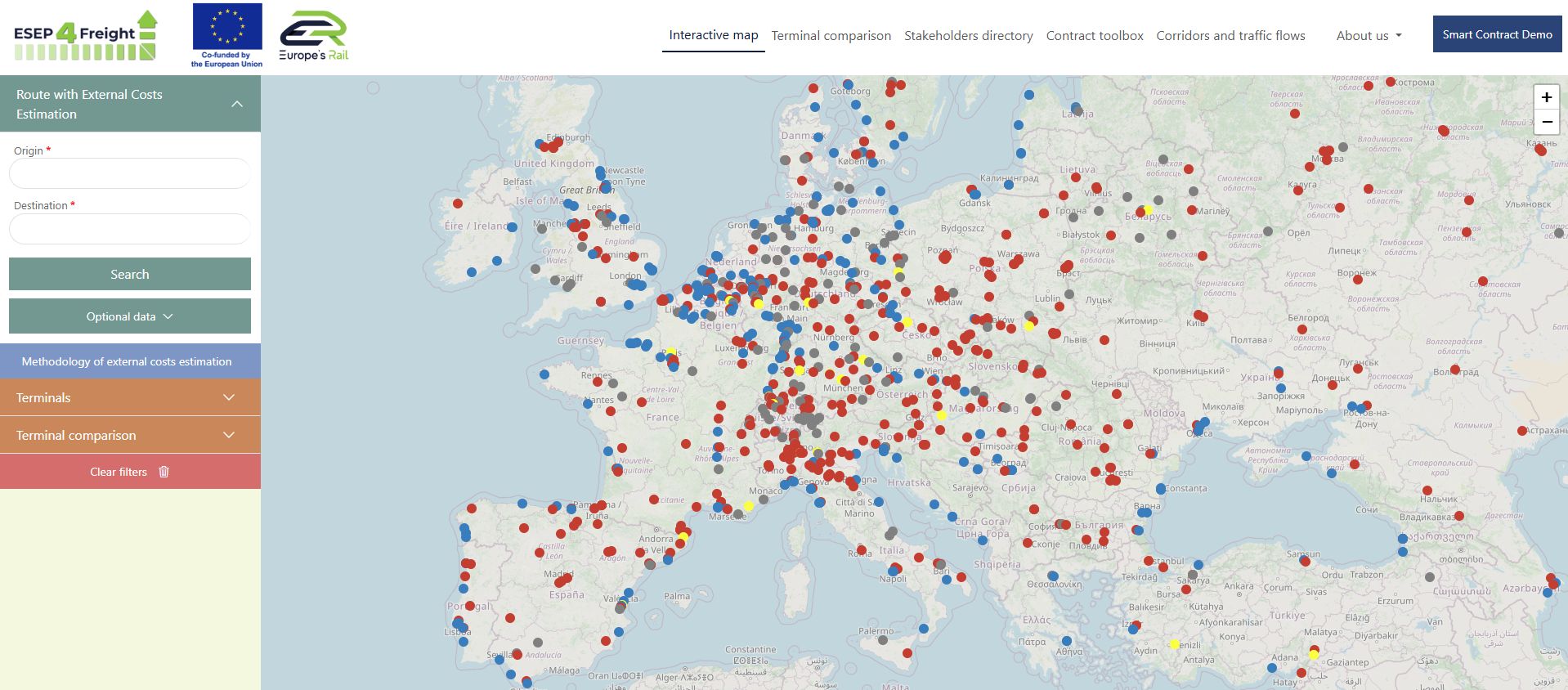
In the future European mobility system, freight rail will play a crucial role in reducing carbon emissions and achieving the goals of the European Green Deal. Our EU-Rail project ESEP4Freight successfully came to an end on 31 August 2025, providing freight customers and stakeholders with an overview of available rail freight services across Europe through its web platform.
At the core of the platform is an interactive map that displays intermodal terminals and enables users to plan routes primarily by rail, with the option to incorporate available barge connections. Key features include visualisation of TEN-T rail corridors, infrastructure characteristics and freight volumes. It also features schedules to access rail and barge timetables and optimise planning and a searchable database of intermodal actors across Europe for easy matchmaking.